The Sedgwick Medical Release form plays a crucial role in the management of medical claims, particularly in the context of workers’ compensation and disability benefits. By signing this form, individuals grant permission for healthcare providers to share their medical information with Sedgwick Claims Management Services, Inc. This encompasses a wide range of medical, health, psychological, and psychiatric records, including details about pre-existing conditions. The form ensures that Sedgwick can facilitate the processing of claims efficiently, allowing for the necessary communication between healthcare providers and claims managers. Importantly, it also addresses the handling of sensitive information, including data related to HIV, psychiatric conditions, and substance abuse, while adhering to the Genetic Information Nondiscrimination Act, which protects individuals from discrimination based on genetic information. Understanding the scope and implications of this authorization is vital, as it impacts how personal health information is shared and utilized throughout the claims process. Furthermore, the form outlines the rights of individuals regarding the revocation of authorization, ensuring that they can manage their medical information with agency and awareness. Overall, the Sedgwick Medical Release form serves as a foundational document in navigating the complexities of health-related claims, providing both clarity and protection for individuals seeking benefits.
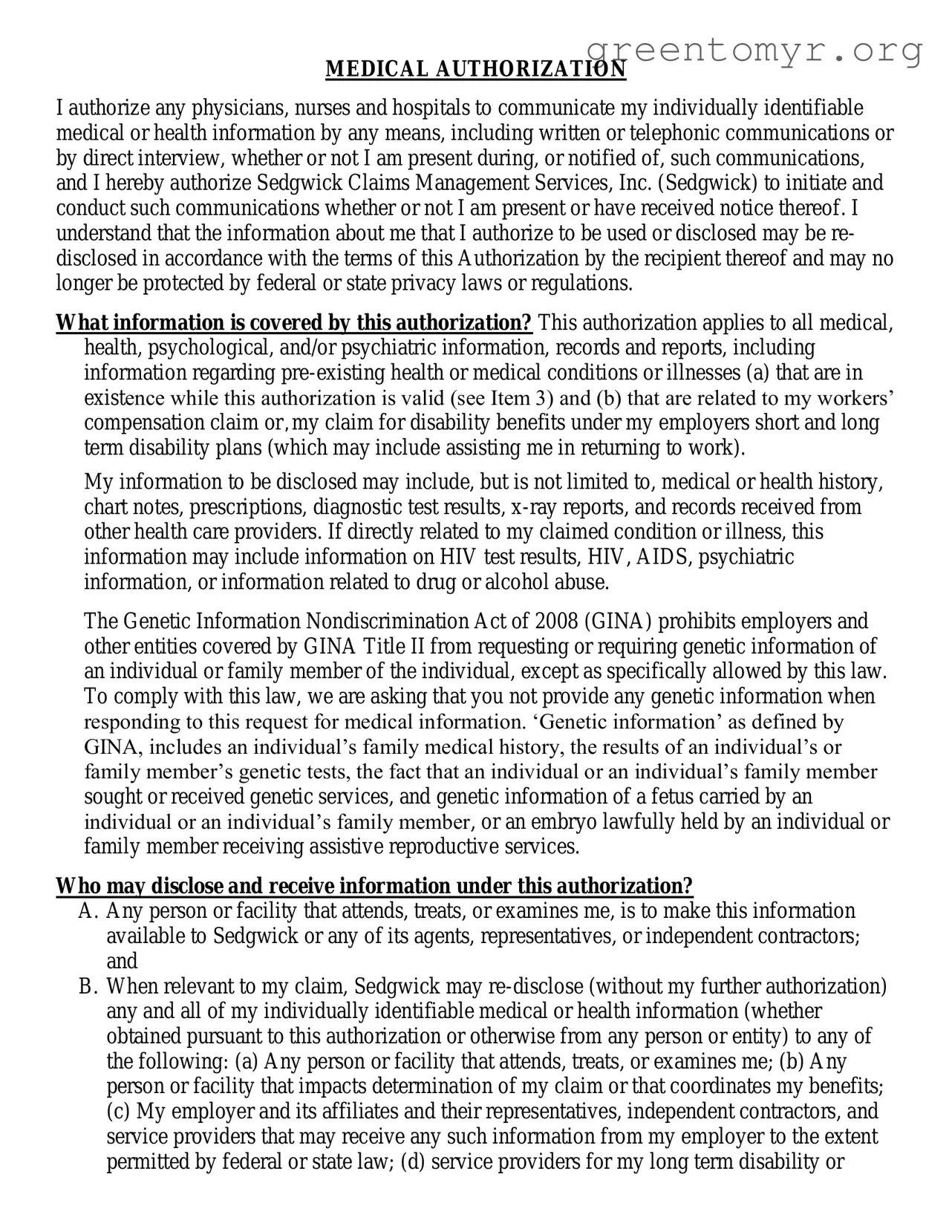
MEDICAL AUTHORIZATION
I authorize any physicians, nurses and hospitals to communicate my individually identifiable medical or health information by any means, including written or telephonic communications or by direct interview, whether or not I am present during, or notified of, such communications, and I hereby authorize Sedgwick Claims Management Services, Inc. (Sedgwick) to initiate and conduct such communications whether or not I am present or have received notice thereof. I understand that the information about me that I authorize to be used or disclosed may be re- disclosed in accordance with the terms of this Authorization by the recipient thereof and may no longer be protected by federal or state privacy laws or regulations.
What information is covered by this authorization? This authorization applies to all medical, health, psychological, and/or psychiatric information, records and reports, including information regarding
My information to be disclosed may include, but is not limited to, medical or health history, chart notes, prescriptions, diagnostic test results,
The Genetic Information Nondiscrimination Act of 2008 (GINA) prohibits employers and other entities covered by GINA Title II from requesting or requiring genetic information of an individual or family member of the individual, except as specifically allowed by this law. To comply with this law, we are asking that you not provide any genetic information when responding to this request for medical information. ‘Genetic information’ as defined by GINA, includes an individual’s family medical history, the results of an individual’s or family member’s genetic tests, the fact that an individual or an individual’s family member sought or received genetic services, and genetic information of a fetus carried by an individual or an individual’s family member, or an embryo lawfully held by an individual or family member receiving assistive reproductive services.
Who may disclose and receive information under this authorization?
A.Any person or facility that attends, treats, or examines me, is to make this information available to Sedgwick or any of its agents, representatives, or independent contractors; and
B.When relevant to my claim, Sedgwick may
(c) My employer and its affiliates and their representatives, independent contractors, and service providers that may receive any such information from my employer to the extent permitted by federal or state law; (d) service providers for my long term disability or
workers’ compensation claim; or (e) The Social Security Administration or a social security or vocational rehabilitation vendor. Sedgwick may use my information obtained pursuant to this authorization in any other claim matter that Sedgwick may administer or handle related to me.
How long is this authorization valid? This authorization is valid during the duration of my claims and any future related claims, unless a different period is required under applicable federal or state law. (Release in connection with a claim for benefits for health insurance may not remain valid longer than the term of coverage of the policy; or for the duration of the claim for all other insurance claims.)
Revocation of this authorization. Unless otherwise provided by federal or state law, I understand that I may revoke this authorization at any time by notifying Sedgwick, in writing, of my revocation and that my revocation shall be effective upon Sedgwick’s receipt of my notice of revocation. I also understand that my revocation of this authorization will not have any effect on any actions taken by Sedgwick before it receives my revocation.
Processing of claims. I understand that this authorization is generally necessary for the processing of my claim. Failure to sign this authorization will likely impair or impede the processing of my claim.
Refusal to sign. I further understand my health care providers will not condition my treatment, payment, enrollment, or eligibility on my refusal to sign this authorization.
I understand that I have the right to request and receive a copy of this authorization. I understand that I have the right to inspect the disclosed information at any time. A photocopy of this authorization shall be valid and is to be accepted with the same effect as the original.
Printed Name of Patient or |
|
|
|
|
Representative’s Relationship to Patient, |
|
|||
Patient’s Representative |
|
|
|
|
if applicable |
|
|
|
|
|
|
|
|
|
|
|
|
||
Claim Number |
Last 4 Digits of Patient’s SSN |
|
Patient’s Date of Birth |
|
|||||
|
|
|
|
|
|
|
|||
Signature of Patient or Patient’s Representative |
|
Date Signed |
|
|
|
||||
Sedgwick 5/2017 |
Sedgwick Claims Management Services, Inc. |
| Fact Name | Fact Description |
|---|---|
| Purpose | The Sedgwick Medical Release form authorizes the disclosure of medical information related to a claim for workers' compensation or disability benefits. |
| Information Covered | This form covers all medical, health, psychological, and psychiatric information, including pre-existing conditions. |
| Disclosure Authorization | Individuals authorize healthcare providers to share their medical information with Sedgwick Claims Management Services. |
| Validity Period | The authorization remains valid for the duration of the claims and any future related claims, unless stated otherwise by law. |
| Revocation | Patients can revoke their authorization at any time by notifying Sedgwick in writing. The revocation takes effect upon receipt. |
| Legal Compliance | The form adheres to the Genetic Information Nondiscrimination Act (GINA), which restricts the use of genetic information. |
| Processing Claims | Signing the authorization is generally necessary for the processing of claims. Refusal may impede the claim process. |
| Patient Rights | Patients have the right to request a copy of the authorization and to inspect the disclosed information at any time. |
After completing the Sedgwick Medical Release form, it will be submitted to Sedgwick Claims Management Services, Inc. for processing. This step is crucial as it allows the necessary medical information to be shared for your claim. Ensure that all information is accurate and complete to avoid any delays.
The Sedgwick Medical Release form is a document that allows healthcare providers to share a patient's medical information with Sedgwick Claims Management Services, Inc. This authorization is crucial for processing claims related to workers' compensation and disability benefits. By signing this form, individuals permit their medical information to be communicated for the purpose of evaluating and managing their claims.
This authorization encompasses a wide range of medical, health, psychological, and psychiatric information. Specifically, it includes:
It is important to note that genetic information is not to be included, as per the Genetic Information Nondiscrimination Act of 2008 (GINA).
Various individuals and entities are authorized to disclose and receive information under this form. These include:
This sharing of information helps ensure that all relevant parties have access to the necessary medical data to facilitate the claims process.
The authorization remains valid for the duration of the claims process and any future related claims. However, certain federal or state laws may dictate different time frames. For instance, a release related to health insurance benefits cannot exceed the coverage term of the policy.
Yes, individuals have the right to revoke the authorization at any time. To do so, a written notice must be sent to Sedgwick. It is essential to understand that revocation will only take effect once Sedgwick receives the notice. Any actions taken by Sedgwick prior to receiving the revocation will not be affected.
While individuals can refuse to sign the authorization, doing so may hinder the processing of their claims. However, healthcare providers cannot condition treatment, payment, or eligibility on the signing of this form. It is important for individuals to weigh the implications of refusing to sign.
Yes, individuals have the right to request and receive a copy of the authorization. They can also inspect any disclosed information at any time. This transparency helps ensure that individuals are aware of what information is shared and with whom.
A photocopy of the Sedgwick Medical Release form is considered valid and holds the same legal weight as the original document. This provision allows for easier access and sharing of the authorization without the need for original signatures in every instance.
Filling out the Sedgwick Medical Release form can be a straightforward process, but there are common mistakes that individuals often make. Recognizing these errors can help ensure that your information is accurately conveyed and your claim is processed efficiently.
One frequent mistake is not providing complete information. Individuals sometimes skip sections or leave fields blank, thinking that certain details are unnecessary. However, every piece of information requested is important for the processing of your claim. Ensure that all sections are filled out thoroughly to avoid delays.
Another common error involves misunderstanding the authorization scope. Some people fail to realize that the authorization allows Sedgwick to communicate with various healthcare providers about all medical information related to their claim. It is crucial to understand that this includes sensitive information, which may be necessary for a comprehensive evaluation of your case.
Additionally, individuals may overlook the importance of signing the form. A signature is required for the authorization to be valid. Without it, the claim process cannot proceed. Double-check to ensure that you have signed and dated the form before submission.
Failing to provide accurate personal details is also a significant mistake. This includes incorrect names, birth dates, or Social Security numbers. Such inaccuracies can lead to confusion and potential delays in processing your claim. Always verify that your information is correct before submitting the form.
Some individuals neglect to understand the implications of revocation. While you have the right to revoke the authorization at any time, it’s important to remember that this revocation will not affect actions taken prior to Sedgwick receiving your notice. Be clear about your intentions and the timing of any revocation.
Lastly, not keeping a copy of the signed authorization can be a detrimental oversight. It is advisable to retain a photocopy for your records. This allows you to reference the authorization if any questions arise later in the claims process.
By being aware of these common mistakes and taking the necessary precautions, you can ensure that your experience with the Sedgwick Medical Release form is as smooth as possible. Your attention to detail will help facilitate the processing of your claim and protect your rights.
The Sedgwick Medical Release form is an essential document in the process of managing medical claims, particularly in relation to workers' compensation and disability benefits. However, several other forms and documents often accompany it to ensure a comprehensive approach to claim management. Below is a list of these documents, each serving a specific purpose in the claims process.
Each of these documents plays a critical role in the claims process, facilitating communication between claimants, healthcare providers, and insurance companies. Understanding their purposes can help ensure that all necessary information is provided, ultimately aiding in the efficient processing of claims.
The Sedgwick Medical Release form shares similarities with several other documents that authorize the sharing of medical information. Below is a list of eight such documents, each with a brief explanation of how they are similar.
When filling out the Sedgwick Medical Release form, it is essential to approach the task with care and attention. Here are four important do's and don'ts to keep in mind:
By following these guidelines, you can help ensure that your experience with the Sedgwick Medical Release form is as smooth as possible. Remember, your health information is sensitive, and it is crucial to handle it with care.
Misconceptions about the Sedgwick Medical Release form can lead to confusion regarding its purpose and implications. Here are nine common misconceptions:
Understanding these misconceptions can help you navigate the medical release process more effectively and protect your rights.
Understanding the Sedgwick Medical Release form is crucial for effective communication of medical information related to claims. Here are ten key takeaways to consider: