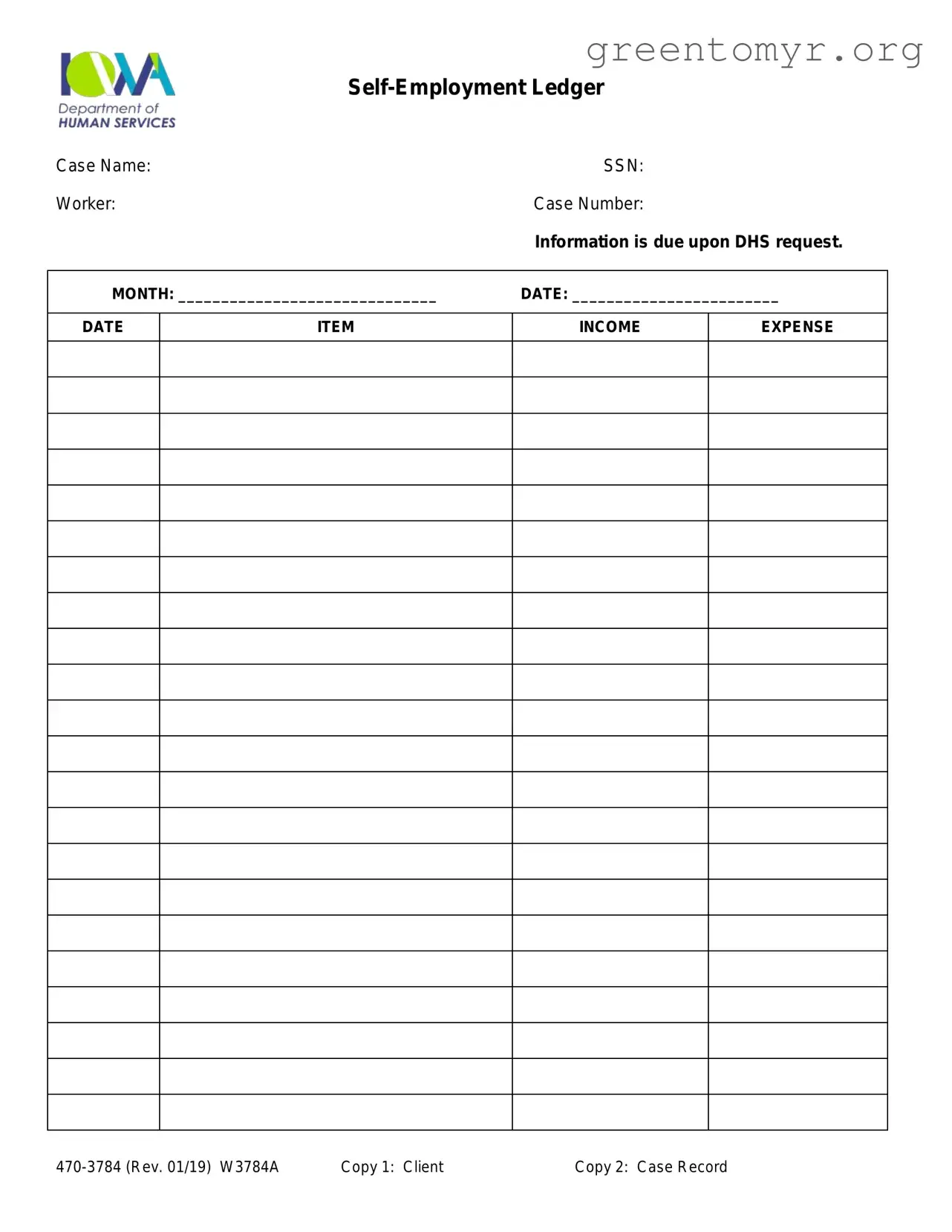
The Self Employment Ledger form plays a crucial role for individuals engaged in self-employment, particularly when interacting with the Iowa Department of Human Services. This form is designed to track and report income and expenses related to self-employment activities. It requires essential information such as the case name, Social Security Number (SSN), worker details, and case number, ensuring that all parties involved have access to necessary identifiers. Each month, users must fill in specific dates, itemizing both income and expenses to provide a clear financial picture. The form emphasizes the importance of timely reporting, as information is due upon request from the Department of Human Services. With its structured format, the Self Employment Ledger not only facilitates accurate record-keeping but also aids in the assessment of eligibility for various benefits or services. Understanding how to effectively utilize this form can lead to better financial management and compliance with state regulations.
Case Name: |
|
SSN: |
|
Worker: |
|
Case Number: |
|
|
|
Information is due upon DHS request. |
|
|
|
|
|
MONTH: ______________________________ |
DATE: ________________________ |
||
|
|
|
|
DATE |
ITEM |
INCOME |
EXPENSE |
|
|
|
|
|
|
|
|
|
|
|
|
|
|
|
|
|
|
|
|
|
|
|
|
|
|
|
|
|
|
|
|
|
|
|
|
|
|
|
|
|
|
|
|
|
|
|
|
|
|
|
|
|
|
|
|
|
|
|
|
|
|
|
|
|
|
|
|
|
|
|
|
|
|
|
|
|
|
|
|
|
|
|
|
|
|
|
|
|
|
|
|
Copy 1: Client |
Copy 2: Case Record |
| Fact Name | Details |
|---|---|
| Form Title | Self-Employment Ledger |
| Governing Authority | Iowa Department of Human Services |
| Case Information | Includes fields for Case Name, SSN, Worker, and Case Number |
| Submission Requirement | Information is due upon request from the Department of Human Services |
| Form Revision Date | Rev. 3/12 |
| Form Copies | Includes Client Copy and Case Record Copy |
Filling out the Self Employment Ledger form is a straightforward process that helps track income and expenses. Follow these steps to ensure all necessary information is recorded accurately.
After completing the form, review all entries for accuracy. Make sure to keep a copy for your records and submit it as required by the Iowa Department of Human Services.
The Self Employment Ledger form is a document used by the Iowa Department of Human Services (DHS) to track income and expenses for individuals who are self-employed. It helps ensure that accurate financial information is reported and is essential for maintaining eligibility for certain benefits.
Individuals who are self-employed and receiving assistance or benefits from the Iowa DHS are required to complete this form. It is crucial for those whose income may affect their eligibility for programs such as food assistance or Medicaid.
The form requires the following information:
You must submit the Self Employment Ledger form whenever the Iowa DHS requests it. It is important to keep your records up to date and ready for review to avoid any interruptions in your benefits.
If you have no income for a month, you still need to complete the form. Indicate zero income in the appropriate section. It's important to be transparent about your financial situation, as this will help maintain your eligibility for benefits.
Failing to submit the Self Employment Ledger form when requested can lead to a review of your benefits. This may result in a temporary or permanent loss of assistance. It is crucial to comply with requests to avoid any negative consequences.
Once you submit the Self Employment Ledger form, any changes must be communicated to the Iowa DHS. If you discover an error or need to update your information, contact your caseworker immediately to discuss the necessary steps.
The Self Employment Ledger form can be obtained from the Iowa Department of Human Services website or through your caseworker. Ensure you are using the most current version of the form to avoid any issues.
There is no fixed deadline for submitting the Self Employment Ledger form, but it must be submitted upon request from the Iowa DHS. Always respond promptly to any requests to ensure you remain compliant with program requirements.
When filling out the Self Employment Ledger form, individuals often overlook important details that can lead to complications. One common mistake is not providing accurate personal information. For instance, omitting the case name or the Social Security Number (SSN) can create significant delays in processing. Each piece of information is crucial for identifying the case and ensuring that the correct records are maintained.
Another frequent error involves the case number. Many people either forget to include it or write it down incorrectly. This number is essential for tracking the case within the system, and inaccuracies can lead to miscommunication with the Department of Human Services (DHS).
Additionally, individuals sometimes fail to complete the month and date sections properly. Leaving these fields blank or providing incorrect information can lead to confusion regarding the reporting period. Each entry must correspond to the correct month and date to ensure that income and expenses are accurately reflected.
When it comes to reporting income, a common mistake is not detailing all sources of revenue. Some may forget to include occasional or irregular income, which can skew the financial picture presented to DHS. It is essential to report every source of income to avoid potential issues later on.
On the other side of the ledger, individuals often misreport expenses. They may either overstate or understate their expenses, which can impact their eligibility for assistance. It is important to maintain accurate records and receipts to support the reported figures.
Another area where errors frequently occur is in the formatting of the entries. People may mix up the order of income and expenses or fail to separate different types of income. Consistency in how information is presented helps in creating a clear and understandable ledger.
Some individuals neglect to update their ledger regularly. Failing to keep the ledger current can lead to discrepancies when the DHS requests information. Regular updates help ensure that all financial data is accurate and reflective of the current situation.
Moreover, individuals sometimes forget to sign and date the form before submission. A missing signature can result in the form being deemed incomplete, causing further delays. It is vital to review the entire form to ensure that all required fields are filled out and that it is properly signed.
Lastly, many people do not keep a copy of the completed Self Employment Ledger for their records. Retaining a copy can be beneficial for future reference and can assist in resolving any disputes or questions that may arise later.
In summary, attention to detail is key when filling out the Self Employment Ledger form. Avoiding these common mistakes can help streamline the process and ensure that all necessary information is accurately reported to the DHS.
The Self Employment Ledger form is an essential document for tracking income and expenses for self-employed individuals. Several other forms and documents complement this ledger, providing additional information or supporting details required by the Iowa Department of Human Services.
These documents work together to create a complete financial picture for self-employed individuals, ensuring compliance with reporting requirements and facilitating accurate assessments by the Department of Human Services.
The Self Employment Ledger form is essential for tracking income and expenses related to self-employment. Several other documents serve similar purposes in different contexts. Here are eight documents that are comparable:
When filling out the Self Employment Ledger form, it's important to follow certain guidelines. Here are ten things to keep in mind:
Following these guidelines will help ensure that your Self Employment Ledger form is completed correctly and efficiently.
Understanding the Self Employment Ledger form can be challenging, and several misconceptions may lead to confusion. Here are nine common misconceptions:
Clarifying these misconceptions can help individuals better navigate the requirements associated with the Self Employment Ledger and ensure compliance with DHS guidelines.
When using the Self Employment Ledger form, keep these key takeaways in mind: