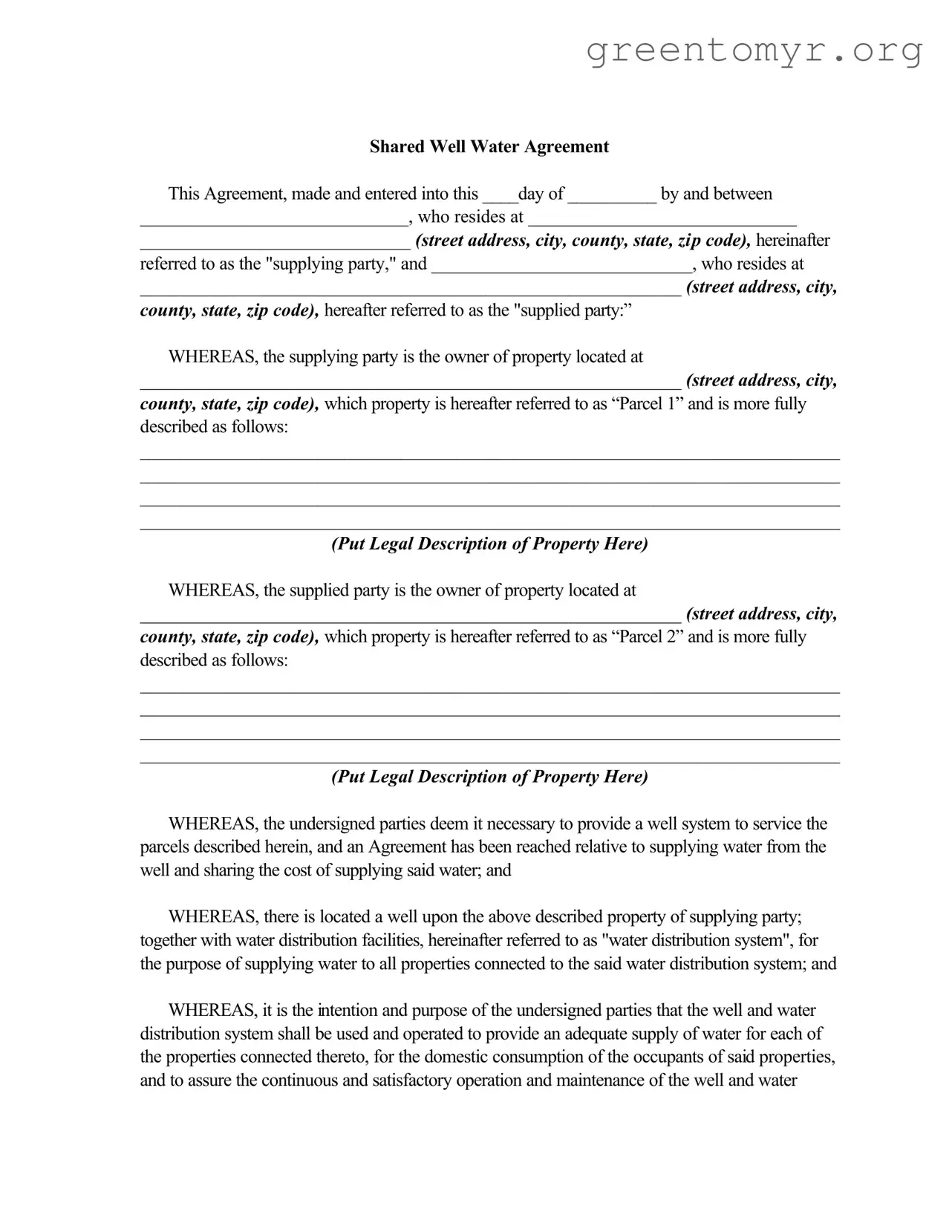
The Shared Well Agreement form is an essential document for property owners who wish to collaboratively utilize a shared water source. This agreement outlines the rights and responsibilities of both the supplying party, who owns the well, and the supplied party, who benefits from the water access. It begins by identifying the properties involved, referred to as Parcel 1 and Parcel 2, and provides a legal description of each parcel. The agreement emphasizes the importance of maintaining a reliable water supply for domestic use, ensuring that all parties can draw water for their households. Key aspects include the establishment of an annual fee for using the well, shared costs for maintenance and operation, and the responsibilities of each party in case of emergencies. Furthermore, the document addresses potential issues such as contamination of the well and the procedures for terminating the agreement if necessary. By clearly defining the terms of use, cost-sharing, and maintenance obligations, the Shared Well Agreement serves to protect the interests of all parties involved while promoting a cooperative approach to water resource management.
Shared Well Water Agreement
This Agreement, made and entered into this ____day of __________ by and between
_____________________________, who resides at _____________________________
_____________________________ (street address, city, county, state, zip code), hereinafter
referred to as the "supplying party," and _____________________________, who resides at
__________________________________________________________ (street address, city,
county, state, zip code), hereafter referred to as the "supplied party:”
WHEREAS, the supplying party is the owner of property located at
__________________________________________________________ (street address, city,
county, state, zip code), which property is hereafter referred to as “Parcel 1” and is more fully described as follows:
___________________________________________________________________________
___________________________________________________________________________
___________________________________________________________________________
___________________________________________________________________________
(Put Legal Description of Property Here)
WHEREAS, the supplied party is the owner of property located at
__________________________________________________________ (street address, city,
county, state, zip code), which property is hereafter referred to as “Parcel 2” and is more fully described as follows:
___________________________________________________________________________
___________________________________________________________________________
___________________________________________________________________________
___________________________________________________________________________
(Put Legal Description of Property Here)
WHEREAS, the undersigned parties deem it necessary to provide a well system to service the parcels described herein, and an Agreement has been reached relative to supplying water from the well and sharing the cost of supplying said water; and
WHEREAS, there is located a well upon the above described property of supplying party; together with water distribution facilities, hereinafter referred to as "water distribution system", for the purpose of supplying water to all properties connected to the said water distribution system; and
WHEREAS, it is the intention and purpose of the undersigned parties that the well and water distribution system shall be used and operated to provide an adequate supply of water for each of the properties connected thereto, for the domestic consumption of the occupants of said properties, and to assure the continuous and satisfactory operation and maintenance of the well and water
distribution system for the benefit of the present and future owners, their heirs, successors and assigns of the properties connected thereto; and
WHEREAS, the said well is deemed by the parties hereto to be of adequate capacity to supply a single family dwelling on each of the parcels described herein with water from the well for all domestic uses of a single family residing therein; and
WHEREAS, the water from the well has undergone a water quality analysis from the State of
___________ health authority and has been determined by the authority to supply safe for human
consumption; and
WHEREAS, the parties hereto desire to enter this Agreement for the purpose of reducing to writing their respective rights and obligations pertaining to said well and water distribution system.
NOW THEREFORE, in consideration of the promises and covenants herein contained, it is agreed that the well and water distribution system situated on Parcel 1 shall be used by the parties to this Agreement, as well as by all future owners and occupants of said Parcels 1 and 2, upon the following terms and conditions:
1.That until this Agreement is terminated, as hereinafter provided, the parties hereto (and their heirs, successors and assigns, for the exclusive benefit of the respective parcels of said real estate, and for the exclusive use of the households residing thereon), are hereby granted the right in common with the other parties to this Agreement, to draw water from the well located on Parcel 1 for domestic use excluding the right to draw water to fill swimming pools of any type.
2.That the owners or residents of the dwellings located on Parcels 2, as of the date of this Agreement shall:
a.Pay or cause to be paid to the supplying party, an annual fee for this use of the well and water distribution system in the amount of $_____________ on or before the 15th of January each year, with the exception of this year whereby the amount shall be $____________ and paid on the execution of this Agreement.
b.Pay or cause to be paid promptly, a proportionate share of all expenses for the operation and maintenance of the well and water distribution system that may become necessary. Each respective share shall be determined by dividing the amount of each expense by two, it being understood that the supplying party and the supplied party shall pay an amount equal to one half of the total of such necessary repair or replacement. Shared expenses include the cost of electricity for pumping, repairs and maintenance on said well and water distribution system.
3.That the cost of any removal or replacement of
parcel necessary for system operation, maintenance, replacement, improvements, inspection or testing, damaged as a result of repair of the well or water distribution system maintenance will be borne by the owner of the affected parcel, except that costs to remove and replace common boundary fencing or walls damaged as a result of repair shall be shared equally between or among parties so damaged.
4.That each of the parties hereby agrees that they will promptly repair, maintain and replace all water pipes or mains serving their respective dwellings.
5.That the consent of all parties to pay a proportionate share of costs shall be obtained prior to embarking upon expenditures for system maintenance, replacement or improvement, except in emergency situations.
6.That the supplied party shall pay to the supplying party his proportionate share for the cost of energy for the operation of the pumping equipment. This cost shall be determined by a separate meter upon each dwelling and for each parcel.
7.That it is the agreement of the parties hereto that the payment for energy cost shall be made not later than the _________day of each succeeding month during the term of this Agreement. In the event that any such payment remains unpaid for a period of ____days, the supplying party may terminate the supply of water to the supplied party until all arrearages in payment are received by the supplying party.
8.That each of the parties to this Agreement does hereby grant to the other, his heirs, successors and assigns, such easements over, across and through the respective parcels as shall be reasonably necessary for the construction of the well, maintenance of water pipes, pumping equipment, mains, electrical wiring and conduit consistent with the purposes of this Agreement. These easements are described below, to wit:
___________________________________________________________________________
___________________________________________________________________________
___________________________________________________________________________
___________________________________________________________________________
(Describe easements, if any)
10.That no party may install landscaping or improvements that will impair the use of said easements.
11.That each party shall have the right to act to correct an emergency situation and shall have access to the pertinent parcel in the absence of the other. An emergency situation shall be defined as
the failure of any shared portion of the system to deliver water upon demand.
12.That only those parcels of real estate hereinabove described and the dwellings located thereon shall be permitted to receive water from said well and pumping equipment; and each of the parties hereto does hereby covenant and agree that he/she will not allow or permit other persons, other than household guests, to take, draw, use or receive water from the well, nor permit other persons to connect to the pipes or mains serving his/her respective parcel.
13.That in the event the referenced well shall become contaminated and shall no longer supply
water suitable for domestic consumption, or shall no longer supply water adequate for the needs of all relevant parties, or in the event that another source of water shall become available to the respective parcels, then the rights and obligations of the parties created by this Agreement shall cease and terminate in accordance with the terms and conditions hereinafter described.
14.That upon the availability of such other source of water, it is contemplated that a reasonable time shall be allowed to effectuate the necessary connections to the new source.
15.That the respective rights and obligations of the parties shall continue until the parties who wish to terminate their participation in the Well Agreement have executed and filed a written statement of termination at the _____________________________ (office where deeds in your state are recorded) of the County of ____________ and the state of ____________________. Upon termination of participation in this Agreement, the owner and occupant of each residence which is terminated from the Agreement shall have no further right to the use of the well. The terminated parties shall disconnect their respective lateral connection from said well system and shall have no further obligation to pay or collect for maintenance and related expenses incurred thereafter. The costs of disconnection from the well and water system shall be borne by the owner of the pertinent parcel.
19.That the term of this Agreement shall be perpetual, except as herein limited.
20.That the benefits and burdens of this Agreement shall constitute a covenant running with the parcels of land herein described and shall be binding upon the heirs, successors in title and assigns of the parties hereto.
21. Any dispute under this Agreement shall be required to be resolved by binding arbitration |
of |
the parties hereto. If the parties cannot agree on an arbitrator, each party shall select one |
|
arbitrator and both arbitrators shall then select a third. The third arbitrator so selected shall |
|
arbitrate said dispute. The arbitration shall be governed by the rules of the American |
|
Arbitration Association then in force and effect. |
|
Witness our signatures this the ____ day of __________, 20____. |
|
__________________________________________________
(Acknowledgment before a notary public, the form of which will vary by state)
| Fact Name | Fact Description |
|---|---|
| Parties Involved | The agreement is between a supplying party and a supplied party, each owning property that will utilize the shared well. |
| Parcel Identification | Each party's property is referred to as Parcel 1 and Parcel 2, with specific legal descriptions required. |
| Water Quality | The water from the well must pass a quality analysis from the state health authority, ensuring it is safe for human consumption. |
| Cost Sharing | Both parties share the costs of maintenance and operation of the well and water distribution system, typically split evenly. |
| Annual Fee | The supplied party must pay an annual fee for the use of the well, with a specific amount due by January 15 each year. |
| Emergency Access | Each party has the right to access the other's property in emergency situations to ensure the system operates properly. |
| Easements | Parties grant easements for necessary construction and maintenance of the well and water distribution system. |
| Termination Conditions | The agreement can be terminated if the well becomes contaminated or if a new water source becomes available. |
| Perpetual Agreement | The term of the agreement is perpetual unless terminated under specified conditions. |
| Dispute Resolution | Any disputes arising from the agreement must be resolved through binding arbitration, following specific procedural rules. |
Filling out the Shared Well Agreement form is a straightforward process. Follow these steps carefully to ensure that all necessary information is included. Once completed, the form will need to be signed and may require notarization, depending on your state’s requirements.
A Shared Well Agreement is a legal document that outlines the terms and conditions under which two or more property owners share a single water well and its distribution system. This agreement specifies the rights and responsibilities of each party regarding the use, maintenance, and costs associated with the well. It aims to ensure that all parties have access to a reliable water supply while clearly defining their obligations to maintain the system.
The parties involved typically include the "supplying party," who owns the property where the well is located, and the "supplied party," who benefits from the water supplied by that well. Each party must provide their legal names and addresses, along with a description of their respective properties, which are referred to as Parcel 1 and Parcel 2 in the agreement.
The supplied party is responsible for several financial obligations, including:
These obligations ensure that the well system remains operational and well-maintained for all parties involved.
If the well becomes contaminated and is no longer suitable for domestic use, or if another water source becomes available, the rights and obligations outlined in the Shared Well Agreement will cease. The parties must then work together to transition to the new water source, allowing a reasonable time for necessary connections to be made. This clause protects the interests of all parties and ensures they have access to safe water.
Each party is responsible for promptly repairing and maintaining the water pipes or mains serving their respective properties. Additionally, any shared expenses for maintenance or repairs must be agreed upon by all parties before work begins, except in emergency situations. In emergencies, any party can act to resolve the issue but should inform the others as soon as possible.
The Shared Well Agreement is intended to be perpetual, meaning it remains in effect until one or more parties choose to terminate their participation. Termination requires a written statement to be filed with the appropriate county office. Upon termination, the affected parties will no longer have the right to use the well and must disconnect their water supply, with disconnection costs borne by the owner of the affected parcel.
Filling out a Shared Well Agreement form can be a straightforward process, but there are common mistakes that individuals often make. These errors can lead to misunderstandings or even disputes down the line. Here are ten mistakes to avoid when completing this important document.
One common mistake is failing to provide complete information. Each party must accurately fill in their names, addresses, and legal descriptions of their properties. Missing or incorrect details can create confusion regarding ownership and responsibilities. Always double-check that all fields are filled out correctly.
Another frequent error is neglecting to specify the annual fee for using the well. The form requires an amount to be filled in, which should reflect a fair agreement between the parties. Leaving this section blank or entering an arbitrary number can lead to disputes about costs later.
People often overlook the importance of clearly defining the easements. These easements are crucial for maintenance and access to the well and water distribution system. If the description is vague or incomplete, it may hinder necessary repairs or create access issues in the future.
Additionally, parties sometimes forget to address the payment timeline for energy costs associated with the well. It is essential to specify the due date for these payments. If not stated clearly, one party may assume a different timeline, leading to potential conflicts.
Another mistake involves not understanding the implications of terminating the agreement. The form outlines the process for termination, including filing a written statement. Failing to follow these steps can result in continued obligations, even after one party believes they have exited the agreement.
Some individuals also neglect to discuss how shared expenses will be handled. The agreement states that costs should be split equally, but if one party is unaware of this, it may lead to disagreements regarding who is responsible for payments.
People sometimes misinterpret the clause about landscaping and improvements. The form clearly states that no party may install landscaping that would impair easements. Ignoring this could lead to disputes over property modifications that interfere with access to the well.
Another common oversight is failing to document emergency procedures. The agreement mentions that each party can act in emergencies, but it’s crucial to communicate and understand what constitutes an emergency. This clarity can prevent confusion when urgent situations arise.
Finally, parties may not realize the importance of having the agreement notarized. This step adds a layer of legitimacy and can help prevent disputes about the authenticity of the signatures. Notarization is an essential part of the process that should not be overlooked.
By being aware of these common mistakes, individuals can fill out the Shared Well Agreement form more effectively. Taking the time to ensure accuracy and clarity can lead to a smoother relationship between parties and prevent future conflicts.
The Shared Well Agreement is a critical document for parties sharing a well system. Several other forms and documents often accompany this agreement to ensure clarity and compliance among the involved parties. Below is a list of related documents that may be necessary in conjunction with the Shared Well Agreement.
These documents work together to create a comprehensive framework for the shared use of a well. Properly managing these agreements helps ensure a reliable water supply and fosters cooperation among all parties involved.
When filling out the Shared Well Agreement form, it's important to pay attention to detail and follow some guidelines to ensure everything goes smoothly. Here’s a list of things to do and avoid:
By following these guidelines, you can help ensure that the Shared Well Agreement is completed correctly and effectively. This will protect the interests of all parties involved and create a clear understanding of rights and responsibilities.
Here are some common misconceptions about the Shared Well Agreement form:
Filling out and using the Shared Well Agreement form is an important step for those sharing a well and water distribution system. Here are some key takeaways to consider: