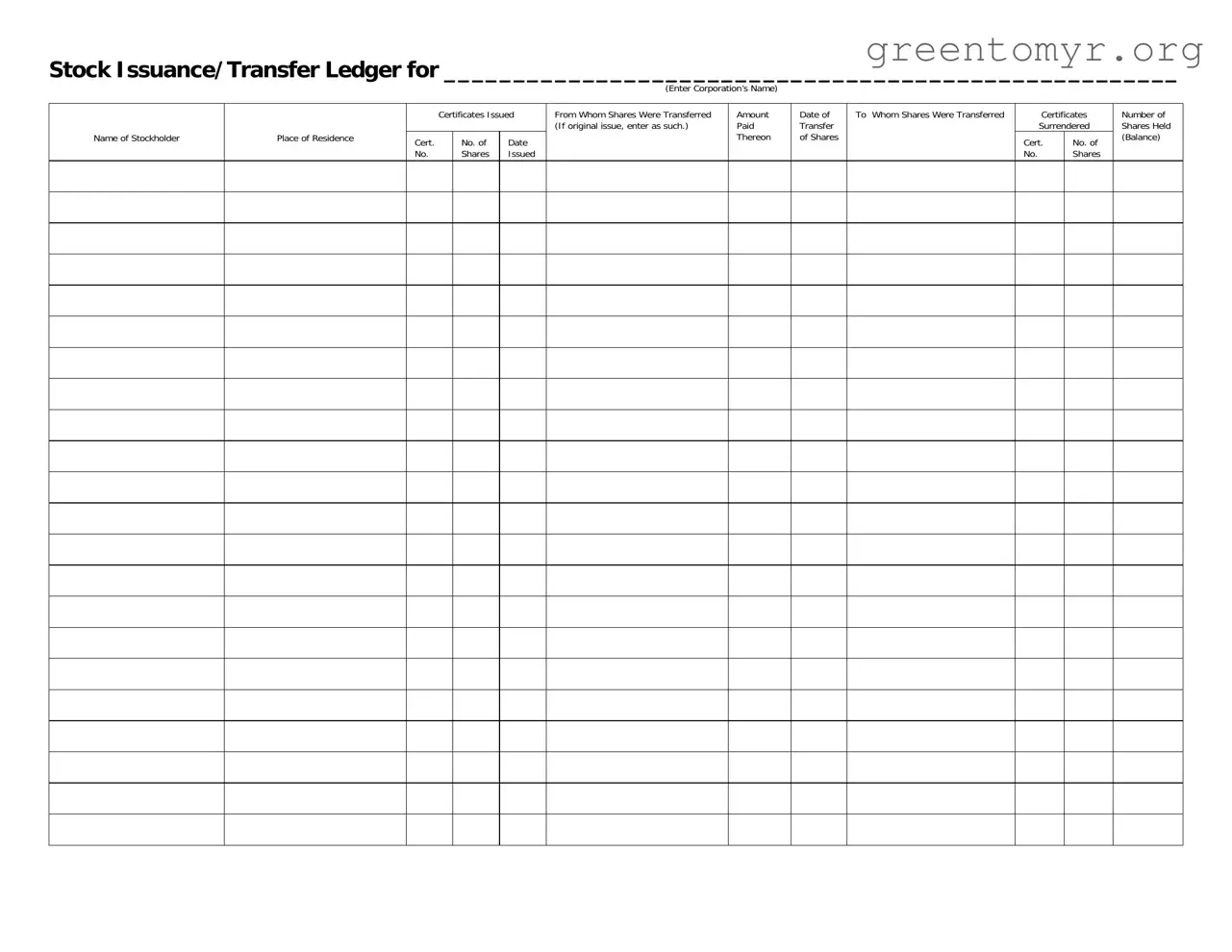
The Stock Transfer Ledger form serves as a crucial document for corporations, detailing the movement of stock ownership among shareholders. This form captures essential information, beginning with the corporation's name, ensuring clear identification of the entity involved. It lists the names of stockholders along with their places of residence, providing a comprehensive overview of ownership. The ledger records the certificates issued, including their corresponding certificate numbers and the dates they were issued. Additionally, it specifies the number of shares transferred and the source of those shares, allowing for transparency in ownership changes. If the shares are part of an original issuance, this is noted as well. The form also documents the amount paid for the shares, the date of transfer, and the recipient of the transferred shares. Lastly, it includes details about the certificates surrendered, ensuring that all transactions are properly accounted for, and concludes with the balance of shares held by each stockholder. This thorough documentation not only aids in maintaining accurate records but also facilitates smooth transactions within the corporate structure.

Stock Issuance/Transfer Ledger for _____________________________________________________
(Enter Corporation’s Name)
Name of Stockholder
Place of Residence
Certificates Issued
Cert. |
No. of |
Date |
No. |
Shares |
Issued |
From Whom Shares Were Transferred (If original issue, enter as such.)
Amount
Paid
Thereon
Date of
Transfer
of Shares
To Whom Shares Were Transferred
Certificates
Surrendered
Cert. |
No. of |
No. |
Shares |
Number of Shares Held (Balance)
| Fact Name | Details |
|---|---|
| Purpose | The Stock Transfer Ledger form tracks the issuance and transfer of stock shares within a corporation. |
| Corporation Identification | The form requires the corporation's name to be clearly stated at the top. |
| Stockholder Information | It includes the name and place of residence of the stockholder involved in the transaction. |
| Certificates Issued | Details about the certificates issued are recorded, including certificate numbers and dates. |
| Transfer Details | The form captures information about the transfer of shares, including the amount paid and the date of transfer. |
| Original Issue Notation | If applicable, the form allows for the notation of original stock issues in the transfer section. |
| Balance Tracking | The ledger helps maintain an accurate balance of shares held by each stockholder. |
| Governing Laws | State-specific forms may be governed by corporate laws, such as the Delaware General Corporation Law. |
Once you have gathered all the necessary information, you can begin filling out the Stock Transfer Ledger form. This form will help you document the transfer of stock ownership clearly and accurately. Follow the steps below to complete it effectively.
The Stock Transfer Ledger form is a document used by corporations to record the issuance and transfer of stock shares. It helps maintain an accurate record of stock ownership and transfers, ensuring that all transactions are documented properly.
Maintaining a Stock Transfer Ledger is crucial for several reasons:
The Stock Transfer Ledger requires the following information:
The responsibility for filling out the Stock Transfer Ledger typically falls to the corporation’s secretary or another designated officer. This person ensures that all information is accurate and up-to-date, reflecting any changes in stock ownership.
The Stock Transfer Ledger should be updated promptly whenever there is a transfer of shares. This ensures that the record remains current and accurately reflects the ownership of the corporation's stock.
If an error is discovered in the Stock Transfer Ledger, it is important to correct it immediately. This can involve making a note of the correction, along with the date and the person making the correction. Maintaining transparency and accuracy is key to preventing potential disputes.
Yes, many corporations choose to maintain their Stock Transfer Ledger electronically. Electronic ledgers can offer advantages such as easier access, better security, and streamlined updates. However, it is essential to ensure that electronic records comply with any applicable laws and regulations.
Once the Stock Transfer Ledger is filled out, it should be securely stored. Access should be limited to authorized personnel only. Keeping a backup, whether in physical or electronic form, is also advisable to prevent loss of data.
While there is no universally mandated format for the Stock Transfer Ledger, it should include all the necessary information as outlined previously. Corporations can customize their ledger to suit their needs, but it must remain clear and organized for effective record-keeping.
Failing to maintain a Stock Transfer Ledger can lead to significant legal issues. Without proper documentation of stock ownership, a corporation may face challenges in proving ownership rights, distributing dividends, or resolving disputes. This can also result in penalties or legal action against the corporation.
Filling out the Stock Transfer Ledger form can be straightforward, but many people make common mistakes that can lead to complications later. One frequent error is failing to enter the corporation’s name at the top of the form. This detail is crucial, as it identifies which company the stock transfer pertains to. Without it, the entire document may be deemed incomplete.
Another mistake involves incorrectly listing the name of the stockholder. It's essential to ensure that the name matches the official records. Typos or variations can create confusion and may delay the transfer process. Always double-check the spelling and accuracy of this information.
People often overlook the place of residence of the stockholder. This section is not just a formality; it helps establish the identity of the stockholder. Missing or incorrect addresses can lead to issues with notifications or legal documents in the future.
When it comes to the certificates issued, some individuals forget to include the certificate numbers. Each certificate should have a unique number, and omitting this can result in problems when tracking ownership. Always ensure that the certificate numbers are correctly recorded.
Another common oversight is in the section regarding the amount paid for the shares. Some people either leave this blank or provide incorrect figures. This information is critical for maintaining accurate financial records and ensuring compliance with tax obligations.
Additionally, the date of transfer is sometimes filled out incorrectly or omitted altogether. This date is vital for establishing when the transfer occurred, which can impact various legal and financial matters. Always confirm that the date is accurate and clearly written.
Lastly, many individuals fail to properly complete the section about certificates surrendered. If certificates are being exchanged, it’s essential to indicate which ones are being surrendered. This helps to prevent any disputes over ownership in the future. Make sure to list the correct certificate numbers and the number of shares involved.
The Stock Transfer Ledger form is an essential document for tracking the issuance and transfer of shares within a corporation. Alongside this form, several other documents are commonly utilized to ensure proper record-keeping and compliance with corporate governance. Below are four key forms often associated with the Stock Transfer Ledger.
These documents work together to create a comprehensive framework for managing stock ownership and transfers. Proper use of each form ensures clarity and legality in corporate transactions.
The Stock Transfer Ledger form is an important document in the realm of corporate governance and stock management. It serves as a record of stock issuance and transfers, detailing key information about shareholders and their transactions. Here are nine other documents that share similarities with the Stock Transfer Ledger form:
When filling out the Stock Transfer Ledger form, there are important guidelines to follow. Here’s a list of things you should and shouldn’t do:
Following these guidelines will help ensure that your Stock Transfer Ledger form is completed correctly and efficiently.
Misconceptions about the Stock Transfer Ledger form can lead to confusion. Below are eight common misunderstandings along with clarifications.
While it is commonly used by corporations, any entity that issues stock can utilize the Stock Transfer Ledger form.
Stockholders can be listed on separate pages if the ledger is extensive. There is no requirement for a single-page format.
Both new transfers and original issuances must be documented. It's important to maintain accurate records for all transactions.
While it is common practice to surrender certificates, electronic records may suffice depending on the corporation's policies.
The amount paid for shares is a crucial detail that helps maintain transparency and accountability in stock transactions.
Updates should occur whenever there is a change in ownership, including gifts or transfers between family members.
Corrections can be made, but they should be documented properly to ensure the integrity of the ledger.
While the secretary often oversees the ledger, other authorized personnel may also manage it, provided they follow company protocols.
Filling out the Stock Transfer Ledger form accurately is crucial for maintaining clear records of stock ownership. Here are some key takeaways to consider:
By following these guidelines, you can ensure that the Stock Transfer Ledger form serves its purpose effectively and maintains accurate records of stock ownership.