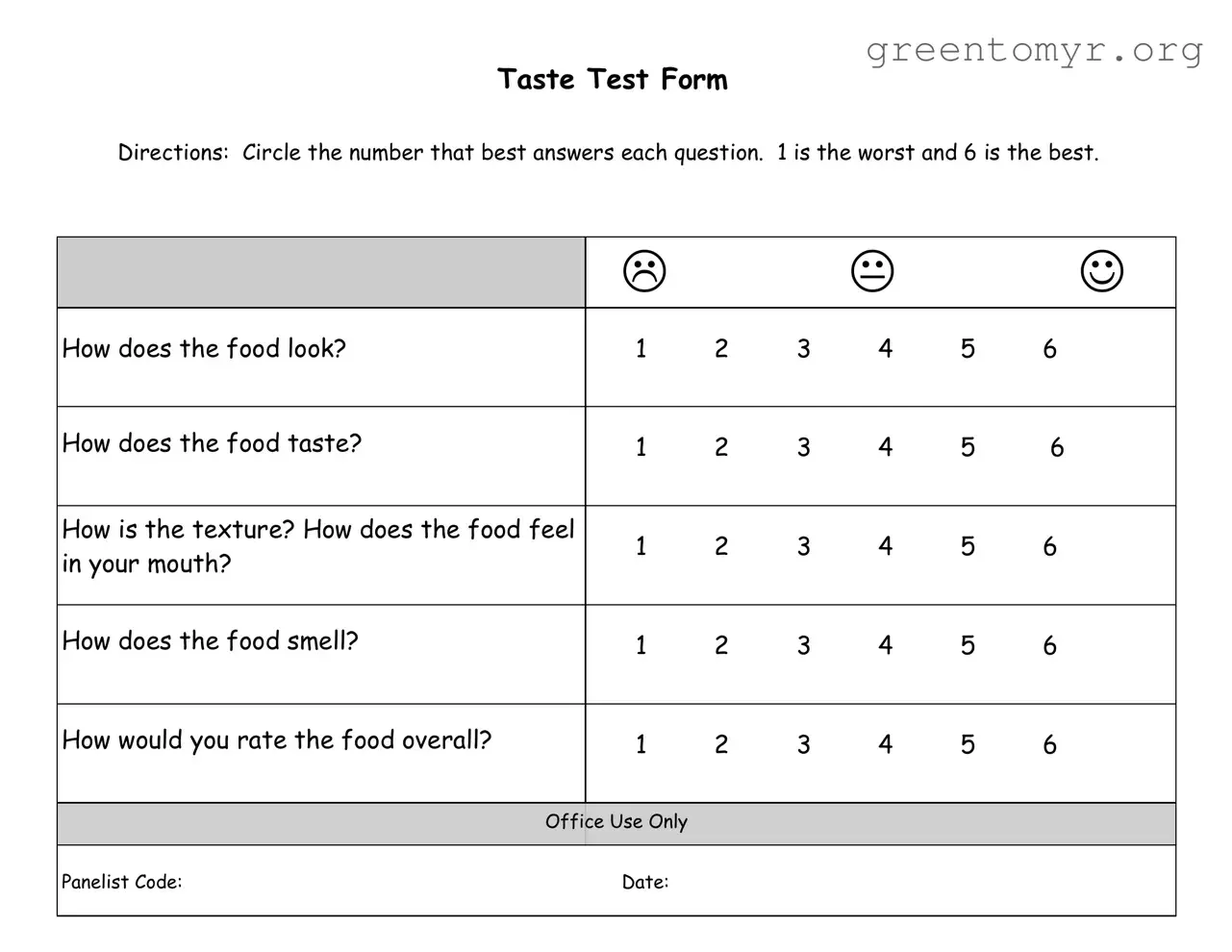
The Taste Test form serves as a valuable tool for gathering feedback on food products. Designed to evaluate various sensory aspects, it allows participants to provide their opinions on appearance, taste, texture, and aroma. Each question is rated on a scale from 1 to 6, with 1 indicating the lowest quality and 6 representing the highest. This straightforward approach makes it easy for panelists to express their preferences. Additionally, the form includes a section for overall ratings, summarizing the panelist's experience with the food item. For organizational purposes, a space for the panelist code and date is also provided. By utilizing this form, companies can gain insightful data to enhance their culinary offerings.
TASTE TEST FORM
Directions: Circle the number that best answers each question. 1 is the worst and 6 is the best.
|
|
|
|
|
|
|
|
How does the food look? |
|
1 |
2 |
3 |
4 |
5 |
6 |
|
|
|
|
|
|
|
|
How does the food taste? |
|
1 |
2 |
3 |
4 |
5 |
6 |
|
|
|
|
|
|
|
|
How is the texture? How does the food feel |
1 |
2 |
3 |
4 |
5 |
6 |
|
in your mouth? |
|
||||||
|
|
|
|
|
|
|
|
|
|
|
|
|
|
|
|
How does the food smell? |
|
1 |
2 |
3 |
4 |
5 |
6 |
|
|
|
|
|
|
|
|
How would you rate the food overall? |
|
1 |
2 |
3 |
4 |
5 |
6 |
|
|
|
|
|
|
|
|
|
Office Use Only |
|
|
|
|
|
|
|
|
|
|
|
|
|
|
Panelist Code: |
|
Date: |
|
|
|
|
|
|
|
|
|
|
|
|
|
| Fact Name | Details |
|---|---|
| Purpose | The Taste Test form is designed to gather feedback on food items based on appearance, taste, texture, smell, and overall rating. |
| Rating Scale | The form uses a numerical scale from 1 to 6, where 1 indicates the worst experience and 6 indicates the best experience. |
| Structure | The form consists of five questions, each focusing on a different sensory aspect of the food being evaluated. |
| Panelist Information | There is a section for office use that includes a panelist code and the date of the taste test. |
| Governing Laws | The use of the Taste Test form may be subject to state-specific food safety regulations, such as the Food Safety Modernization Act (FSMA) in the U.S. |
Once you have the Taste Test form in front of you, you will be ready to share your impressions of the food. Your feedback is valuable and will contribute to understanding the overall experience. Below are the steps to complete the form accurately.
The Taste Test form is designed to gather feedback on food items. Participants evaluate various aspects of the food, including appearance, taste, texture, smell, and overall impression. This feedback helps food developers and companies improve their products based on consumer preferences.
To complete the form, simply circle the number that best represents your opinion for each question. The scale ranges from 1 to 6, where 1 indicates the worst experience and 6 indicates the best. Take your time to assess each aspect carefully before making your selection.
The form evaluates five key aspects of the food:
Each of these aspects plays a crucial role in the overall enjoyment of the food.
Yes, the rating system is straightforward. You will use a scale from 1 to 6. A rating of 1 means you found that aspect very unsatisfactory, while a rating of 6 means you found it exceptional. Choose the number that best reflects your experience for each question.
If you have questions while completing the Taste Test form, don't hesitate to ask a facilitator or the person in charge of the taste test. They are there to assist you and ensure you have a clear understanding of the process.
The Panelist Code is a unique identifier assigned to you as a participant. It helps ensure that your feedback remains anonymous while still allowing the organizers to track responses. The Date is important for record-keeping, as it indicates when the taste test took place.
While the Taste Test form focuses on specific ratings, many taste tests allow for additional comments. If there is a section for comments, feel free to share your thoughts. Your insights can provide valuable context to your ratings and help improve future products.
When filling out the Taste Test form, many people inadvertently make mistakes that can affect the overall accuracy of the feedback provided. One common error is not paying close attention to the rating scale. The form uses a scale from 1 to 6, where 1 represents the worst experience and 6 signifies the best. Some individuals mistakenly circle numbers that do not align with their true feelings about the food. This can lead to misleading results.
Another frequent mistake involves skipping questions altogether. Each aspect of the food—appearance, taste, texture, smell, and overall rating—plays a crucial role in the evaluation. Omitting responses can result in incomplete data, making it difficult for the team to understand the panelists' experiences. It’s essential to answer every question to provide a comprehensive review.
Panelists sometimes overlook the importance of being specific in their assessments. For instance, a rating of "3" might not convey enough detail about why the food was just average. Adding comments or notes can enhance the feedback, offering insight into what aspects were lacking or what stood out positively. Providing context helps in making informed decisions for future product development.
Another mistake is failing to consider the context of the tasting experience. External factors, such as the environment or personal mood, can influence perceptions of food. It’s important for panelists to reflect on these elements and how they may have impacted their ratings. This awareness can lead to more accurate and useful feedback.
Many people also forget to review their responses before submitting the form. A quick check can catch any errors, such as circling the wrong number or misinterpreting a question. Taking a moment to ensure everything is filled out correctly can significantly improve the quality of the feedback provided.
Some panelists may also be hesitant to use the full range of the rating scale. They might feel compelled to give ratings that are too conservative, clustering around the middle numbers. Encouraging a more varied use of the scale allows for a clearer picture of the food's qualities, leading to more actionable insights.
Lastly, not including the panelist code or date can lead to confusion later on. These details are crucial for tracking responses and analyzing trends over time. Ensuring that all required information is filled out correctly aids in maintaining organized records and facilitates better follow-up if needed.
The Taste Test form is an essential tool for gathering feedback on food products. However, it is often accompanied by several other documents that enhance the data collection process and ensure comprehensive analysis. Below are five commonly used forms and documents that complement the Taste Test form.
Utilizing these additional documents alongside the Taste Test form can lead to more robust data collection and analysis. This comprehensive approach not only enhances the quality of feedback but also supports better product development and consumer satisfaction.
The Taste Test form is similar to several other documents used for gathering feedback and evaluations. Here’s a list of nine documents that share similarities:
When filling out the Taste Test form, it's important to follow some guidelines to ensure your feedback is clear and helpful. Here are seven things to keep in mind:
By following these tips, you can contribute effectively to the taste testing process. Your insights matter and can lead to improvements in the food being evaluated.
There are several misconceptions about the Taste Test form that can lead to confusion. Here are four common ones:
This is not true. Anyone can fill out the Taste Test form. It is designed for anyone who enjoys food and wants to share their opinion.
While taste is important, the form also asks about appearance, texture, and smell. All these factors contribute to the overall experience of the food.
Detailed comments are not required. The form focuses on simple ratings. However, if you want to add comments, feel free to do so!
This form can be used for any kind of food. Whether it’s a snack, a meal, or a dessert, your feedback is valuable.
When utilizing the Taste Test form, several important points should be kept in mind to ensure effective feedback collection.