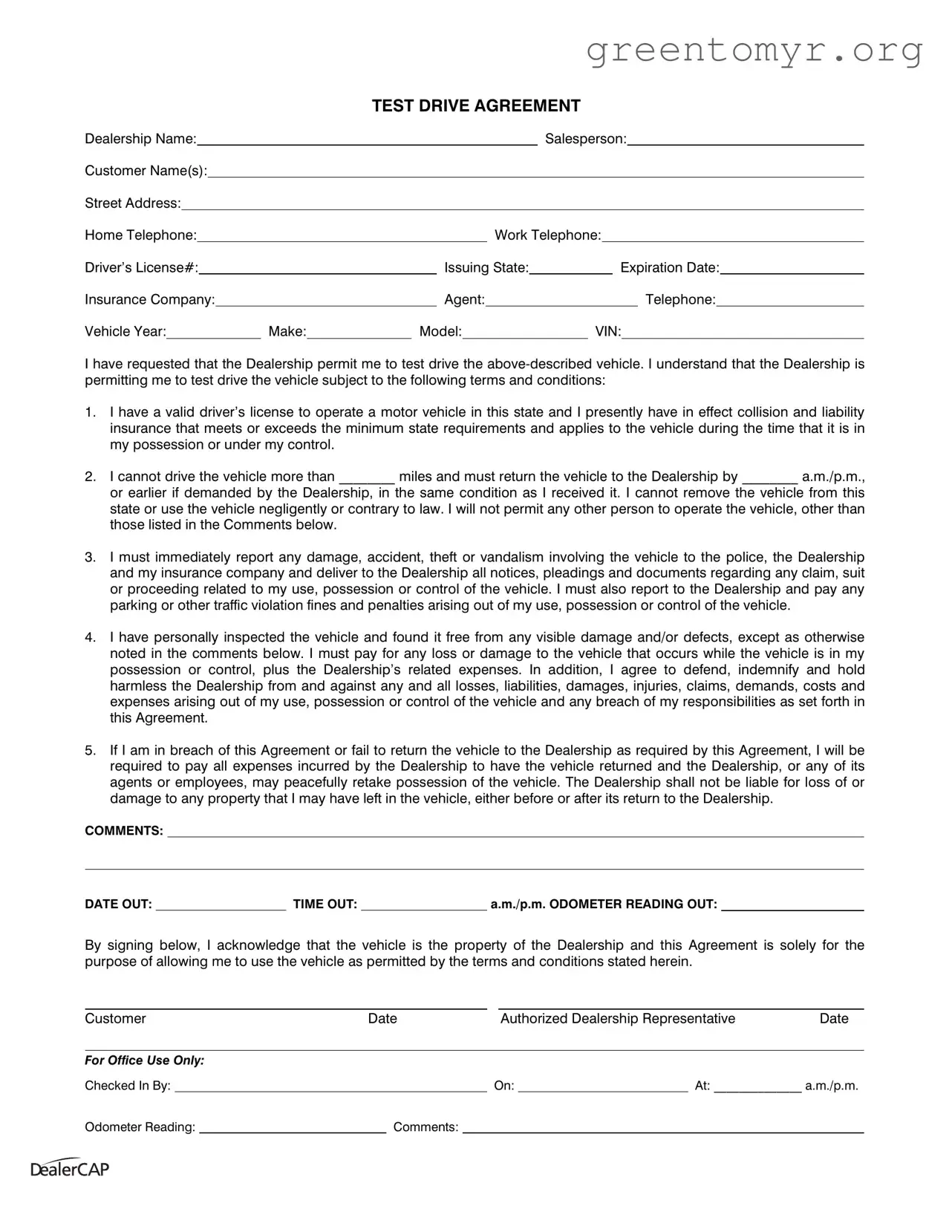
The Test Drive form serves as a crucial document in the car-buying process, facilitating a safe and structured way for potential buyers to experience a vehicle before making a purchase decision. This form captures essential information about both the dealership and the customer, including names, contact details, and the specifics of the vehicle being tested. It outlines the responsibilities of the customer, ensuring they possess a valid driver’s license and adequate insurance coverage that meets state requirements. The form sets clear boundaries on the use of the vehicle, specifying mileage limits and return conditions, which are designed to protect both the customer and the dealership. In addition, it mandates that the customer report any incidents involving the vehicle, such as accidents or damages, thereby promoting accountability. The agreement also includes provisions for indemnification, meaning that the customer agrees to protect the dealership from any claims arising from their use of the vehicle. Furthermore, it emphasizes the dealership's ownership of the vehicle and outlines the consequences of any breach of the agreement. By detailing these terms, the Test Drive form not only safeguards the interests of the dealership but also enhances the customer’s understanding of their obligations during the test drive experience.
TEST DRIVE AGREEMENT
Dealership Name: |
|
|
|
|
|
|
|
|
|
|
Salesperson: |
|
||||||||||||
Customer Name(s): |
|
|
|
|
|
|
|
|
|
|
|
|
|
|
|
|
|
|
|
|||||
Street Address: |
|
|
|
|
|
|
|
|
|
|
|
|
|
|
|
|
|
|
|
|||||
Home Telephone: |
|
|
|
|
|
|
|
|
Work Telephone: |
|
||||||||||||||
Driver’s License#: |
|
|
|
|
|
Issuing State: |
|
|
|
|
Expiration Date: |
|
||||||||||||
Insurance Company: |
|
|
|
|
Agent: |
|
|
|
|
|
|
|
Telephone: |
|
||||||||||
Vehicle Year: |
|
|
Make: |
|
Model: |
|
|
VIN: |
|
|||||||||||||||
I have requested that the Dealership permit me to test drive the
1.I have a valid driver’s license to operate a motor vehicle in this state and I presently have in effect collision and liability insurance that meets or exceeds the minimum state requirements and applies to the vehicle during the time that it is in my possession or under my control.
2.I cannot drive the vehicle more than ________ miles and must return the vehicle to the Dealership by ________ a.m./p.m., or earlier if demanded by the Dealership, in the same condition as I received it. I cannot remove the vehicle from this state or use the vehicle negligently or contrary to law. I will not permit any other person to operate the vehicle, other than those listed in the Comments below.
3.I must immediately report any damage, accident, theft or vandalism involving the vehicle to the police, the Dealership and my insurance company and deliver to the Dealership all notices, pleadings and documents regarding any claim, suit or proceeding related to my use, possession or control of the vehicle. I must also report to the Dealership and pay any parking or other traffic violation fines and penalties arising out of my use, possession or control of the vehicle.
4.I have personally inspected the vehicle and found it free from any visible damage and/or defects, except as otherwise noted in the comments below. I must pay for any loss or damage to the vehicle that occurs while the vehicle is in my possession or control, plus the Dealership’s related expenses. In addition, I agree to defend, indemnify and hold harmless the Dealership from and against any and all losses, liabilities, damages, injuries, claims, demands, costs and expenses arising out of my use, possession or control of the vehicle and any breach of my responsibilities as set forth in this Agreement.
5.If I am in breach of this Agreement or fail to return the vehicle to the Dealership as required by this Agreement, I will be required to pay all expenses incurred by the Dealership to have the vehicle returned and the Dealership, or any of its agents or employees, may peacefully retake possession of the vehicle. The Dealership shall not be liable for loss of or damage to any property that I may have left in the vehicle, either before or after its return to the Dealership.
COMMENTS:
DATE OUT: |
|
TIME OUT: |
|
a.m./p.m. ODOMETER READING OUT: |
By signing below, I acknowledge that the vehicle is the property of the Dealership and this Agreement is solely for the purpose of allowing me to use the vehicle as permitted by the terms and conditions stated herein.
Customer |
Date |
Authorized Dealership Representative |
Date |
|||
|
|
|
|
|
|
|
For Office Use Only: |
|
|
|
|
|
|
Checked In By: |
|
|
On: |
|
At: ______________ a.m./p.m. |
|
Odometer Reading: |
|
Comments: |
| Fact Name | Fact Description |
|---|---|
| Dealership Information | The Test Drive Agreement requires the dealership's name, salesperson, and customer information, including contact details. |
| Driver's License Requirement | The customer must possess a valid driver’s license for the state where the test drive occurs. This ensures that the customer is legally allowed to operate the vehicle. |
| Insurance Coverage | The customer is responsible for having collision and liability insurance that meets state minimum requirements. This insurance must be in effect during the test drive. |
| Vehicle Condition | Before driving, the customer must inspect the vehicle and note any visible damage. They are liable for any damage that occurs while the vehicle is in their possession. |
| Return Conditions | The vehicle must be returned to the dealership by a specified time and within a designated mileage limit. Failure to comply may result in additional charges. |
| Legal Responsibilities | The agreement outlines the customer’s obligation to report any incidents involving the vehicle. This includes accidents, theft, or vandalism, and the customer must handle any related fines. |
Filling out the Test Drive form is an important step in the process of experiencing a vehicle before making a purchase decision. Once the form is completed, the dealership will review the information provided and prepare for your test drive. Below are the steps you need to follow to accurately fill out the form.
Once you have filled out all the required fields, review the information for accuracy. Signing the form will confirm your understanding of the terms and conditions outlined, allowing you to proceed with the test drive.
The Test Drive form serves as an agreement between the dealership and the customer, allowing the customer to test drive a vehicle. It outlines the terms and conditions that the customer must follow during the test drive, ensuring both parties understand their responsibilities and liabilities.
Customers must fill out several key details on the form, including:
As a customer, you have several important responsibilities, including:
No, you cannot allow anyone else to operate the vehicle unless they are specifically listed in the comments section of the form. This restriction is in place to ensure that the dealership can manage liability effectively.
If any damage occurs while the vehicle is in your possession, you are responsible for the costs associated with repairing that damage. Additionally, you may need to cover any related expenses incurred by the dealership.
In the event of an accident, you must immediately report it to the police, the dealership, and your insurance company. It is crucial to document the incident and provide any notices or documents related to the claim back to the dealership.
If you fail to return the vehicle by the specified time, you may incur additional charges. The dealership reserves the right to take possession of the vehicle without force if you breach the agreement.
The dealership is not liable for any loss or damage to personal property left in the vehicle, whether before or after its return. It is advisable to remove all personal belongings before taking the vehicle for a test drive.
If you have any questions or concerns, it is best to discuss them with the dealership representative before signing the form. They can provide clarification on any terms or conditions you may not understand.
When filling out the Test Drive form, several common mistakes can lead to complications or misunderstandings. One frequent error is neglecting to provide complete contact information. It is crucial to fill in all required fields, including home and work telephone numbers. Incomplete contact details can hinder communication between the dealership and the customer, especially in case of emergencies or necessary follow-ups.
Another mistake involves failing to check the validity of the driver’s license. The form requires a valid driver’s license number, along with the issuing state and expiration date. If this information is incorrect or outdated, it may result in the dealership denying the test drive. Always ensure that the driver's license is current and accurately recorded on the form.
Many individuals overlook the importance of specifying the mileage limit and return time. The form includes a section where the customer must indicate how many miles they are allowed to drive the vehicle and the time by which it must be returned. Leaving these sections blank can lead to confusion and potential violations of the agreement, which could result in additional charges or penalties.
Additionally, customers often forget to inspect the vehicle before signing the agreement. The form states that the customer must personally inspect the vehicle and note any visible damage. Skipping this step can lead to disputes over damage that occurs during the test drive. It is advisable to take a moment to examine the vehicle thoroughly and document any pre-existing issues in the comments section.
Finally, not reporting any damage or incidents immediately can be a significant oversight. The agreement requires that any accidents, thefts, or damages be reported right away to the dealership and insurance company. Failing to do so may result in financial liability for damages or complications with insurance claims. Being proactive about reporting issues helps protect both the customer and the dealership.
When engaging in a test drive, several forms and documents accompany the Test Drive Agreement to ensure a smooth and legally sound process. Each of these documents serves a specific purpose, protecting both the dealership and the customer. Understanding these forms can enhance the test drive experience and clarify responsibilities.
These documents work together to create a framework for a safe and responsible test drive experience. Familiarizing oneself with these forms can lead to a more informed and enjoyable process, ensuring that both the dealership and the customer are protected throughout the transaction.
When filling out the Test Drive form, it’s important to approach the process with care and attention. Below is a list of things you should and shouldn’t do to ensure a smooth experience.
By following these guidelines, you can help ensure that your test drive experience is both enjoyable and compliant with the dealership’s policies.
Understanding the Test Drive form is crucial for both customers and dealerships. However, several misconceptions can cloud this understanding. Here are nine common misconceptions:
By addressing these misconceptions, customers can better understand their responsibilities and the terms of the test drive, ensuring a smoother experience for everyone involved.
When filling out and using the Test Drive form, keep these key points in mind:
By keeping these points in mind, you can ensure a smooth and responsible test drive experience.