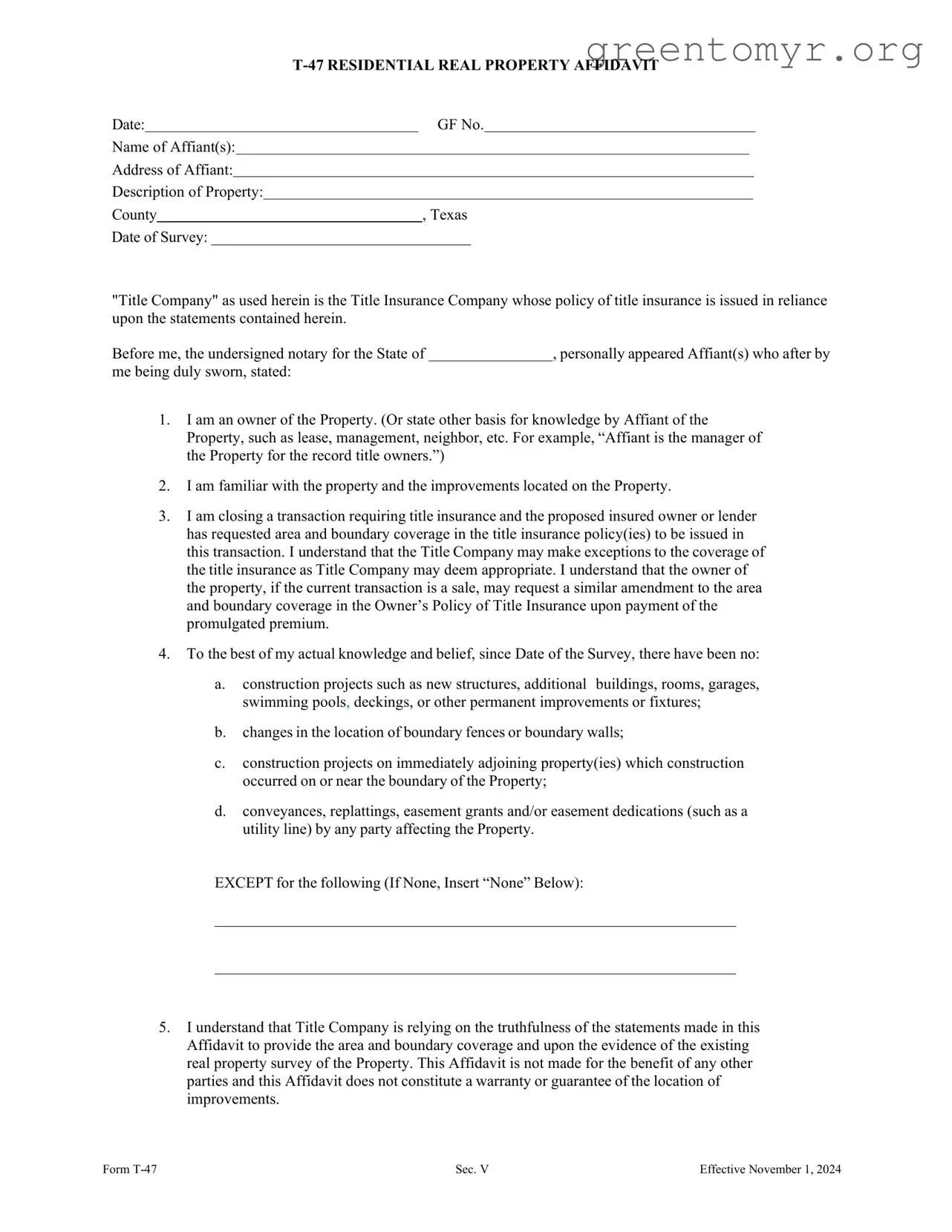
The Texas residential property affidavit T-47 form plays a crucial role in real estate transactions within the state, serving as a vital tool for both buyers and sellers. This form is primarily used to affirm the ownership of a property and to disclose any existing encumbrances or liens that may affect the title. By providing a sworn statement regarding the property's current condition and any potential claims against it, the T-47 form helps facilitate a smoother transfer of ownership. It is typically completed by the seller, who must provide accurate information about the property and its status. The affidavit must be notarized, ensuring the authenticity of the signatures and the accuracy of the statements made. Understanding the importance of this form is essential for anyone involved in a residential property transaction in Texas, as it helps to clarify the legal standing of the property and protects the interests of all parties involved.
|
|
|
|
|
|
||||||
Date: |
|
|
|
GF No. |
|
||||||
Name of Affiant(s): |
|
|
|
|
|
|
|
||||
Address of Affiant: |
|
|
|
|
|
|
|
||||
Description of Property: |
|
|
|
|
|
|
|||||
County |
|
|
|
|
, Texas |
|
|||||
Date of Survey: __________________________________
"Title Company" as used herein is the Title Insurance Company whose policy of title insurance is issued in reliance upon the statements contained herein.
Before me, the undersigned notary for the State of |
|
, personally appeared Affiant(s) who after by |
me being duly sworn, stated: |
|
|
1.I am an owner of the Property. (Or state other basis for knowledge by Affiant of the Property, such as lease, management, neighbor, etc. For example, “Affiant is the manager of the Property for the record title owners.”)
2.I am familiar with the property and the improvements located on the Property.
3.I am closing a transaction requiring title insurance and the proposed insured owner or lender has requested area and boundary coverage in the title insurance policy(ies) to be issued in this transaction. I understand that the Title Company may make exceptions to the coverage of the title insurance as Title Company may deem appropriate. I understand that the owner of the property, if the current transaction is a sale, may request a similar amendment to the area and boundary coverage in the Owner’s Policy of Title Insurance upon payment of the promulgated premium.
4.To the best of my actual knowledge and belief, since Date of the Survey, there have been no:
a.construction projects such as new structures, additional buildings, rooms, garages, swimming pools, deckings, or other permanent improvements or fixtures;
b.changes in the location of boundary fences or boundary walls;
c.construction projects on immediately adjoining property(ies) which construction occurred on or near the boundary of the Property;
d.conveyances, replattings, easement grants and/or easement dedications (such as a utility line) by any party affecting the Property.
EXCEPT for the following (If None, Insert “None” Below):
___________________________________________________________________
___________________________________________________________________
5.I understand that Title Company is relying on the truthfulness of the statements made in this Affidavit to provide the area and boundary coverage and upon the evidence of the existing real property survey of the Property. This Affidavit is not made for the benefit of any other parties and this Affidavit does not constitute a warranty or guarantee of the location of improvements.
Form |
Sec. V |
Effective November 1, 2024 |

6.I understand that I have no liability to Title Company should the information in this Affidavit be incorrect other than information that I personally know to be incorrect and which I do not disclose to the Title Company.
I declare under penalty of perjury that theforegoing is true and correct.
Signed:
__________________________________________
Affiant
I declare under penalty of perjury that theforegoing is true and correct.
Signed:
_________________________________________
Affiant
SWORN AND SUBSCRIBED thisday of, 20 .
________________________________________
Notary Public
Form |
Sec. V |
Effective November 1, 2024 |
| Fact Name | Description |
|---|---|
| Purpose | The T-47 form is used to provide a sworn statement regarding the property and its boundaries. |
| Governing Law | The form is governed by Texas Property Code Section 12.003. |
| Who Uses It | Homeowners, sellers, and lenders typically use the T-47 form during real estate transactions. |
| Affidavit Requirement | The T-47 form serves as an affidavit to confirm the accuracy of property descriptions. |
| Filing Process | The completed T-47 form must be filed with the county clerk's office. |
| Impact on Title Insurance | Title insurance companies often require the T-47 form to issue a policy. |
| Signature Requirement | The form must be signed by the property owner in the presence of a notary public. |
| Validity Period | The T-47 form is generally valid for a period of six months from the date of signing. |
| Boundary Disputes | The form can help resolve boundary disputes by providing a sworn statement of property lines. |
| Availability | The T-47 form can be obtained from real estate agents, title companies, or online legal resources. |
Once you have the Texas residential property affidavit T-47 form ready, you will need to fill it out accurately to ensure it is processed without any issues. Follow these steps carefully to complete the form.
After completing the form, make sure to review all entries for accuracy. Once confirmed, you can submit the form to the appropriate county office or as instructed in your specific situation.
The Texas residential property affidavit T-47 form is a document used in real estate transactions in Texas. It is typically required when a property owner is selling or refinancing their residential property. The form serves to confirm the property’s current condition and to provide information about any improvements made to the property.
The T-47 form must be completed by the property owner or seller. It is often required by lenders, title companies, or buyers during the closing process. Completing the form accurately is essential to ensure a smooth transaction.
The T-47 form includes several key pieces of information, such as:
This information helps establish the property's status and ensures that all parties involved have a clear understanding of its condition.
The completed T-47 form is typically submitted to the title company handling the transaction. The title company will review the form as part of the closing process. It is important to ensure that the form is filled out completely and accurately before submission to avoid delays.
Filling out the Texas residential property affidavit T-47 form can be a straightforward process, but many individuals make common mistakes that can lead to delays or complications. One frequent error is failing to provide accurate property descriptions. The property’s legal description must match what is recorded in the county’s appraisal district. An incorrect description can cause issues in the transfer of ownership.
Another mistake involves not signing the affidavit. While it may seem obvious, some individuals forget to sign the document, rendering it invalid. A missing signature can lead to delays in processing and may require the form to be submitted again.
People often overlook the need for notarization. The T-47 form must be notarized to be considered valid. Without this step, the affidavit cannot be accepted by title companies or lenders, which can halt the closing process.
Inaccurate information about the property’s ownership can also pose problems. Some individuals may mistakenly list the wrong owner or fail to indicate whether the property is held in a trust or by an LLC. This can create confusion and complicate the legal standing of the property.
Another common error is neglecting to check for prior liens or encumbrances. If there are existing liens on the property, these must be disclosed in the affidavit. Failing to do so can lead to legal repercussions and financial liability.
People sometimes misinterpret the purpose of the T-47 form. It is not merely a formality; it serves as a declaration of the property’s current condition and ownership status. Misunderstanding its significance can lead to incomplete or inaccurate submissions.
Providing outdated or incorrect contact information is another frequent mistake. Individuals should ensure that their contact details are current to facilitate communication with title companies or other parties involved in the transaction.
Some individuals may also rush through the form, resulting in incomplete responses. Each section of the T-47 must be filled out thoroughly. Leaving blanks can raise red flags and delay processing.
Additionally, failing to keep a copy of the completed affidavit for personal records is a common oversight. Having a copy can be useful for future reference or in case any disputes arise regarding the property.
Lastly, individuals sometimes ignore deadlines associated with submitting the T-47 form. Being aware of these timelines is crucial to ensure that the transaction proceeds smoothly. Missing a deadline can create unnecessary complications and stress.
The Texas residential property affidavit T-47 form is an important document used in real estate transactions, particularly in relation to property title and ownership. It serves to clarify the ownership of a property and is often accompanied by several other forms and documents that facilitate the transaction process. Below is a list of commonly used forms that complement the T-47 affidavit.
Understanding these documents can greatly enhance the clarity and efficiency of real estate transactions in Texas. Each form plays a specific role in ensuring that all parties are informed and that the transfer of property is conducted smoothly and legally.
The Texas residential property affidavit T-47 form serves a specific purpose in real estate transactions, particularly in clarifying ownership and the status of a property. Several other documents share similarities with the T-47 form, each playing a vital role in property transactions. Below is a list of nine documents that are comparable to the T-47 form, along with a brief explanation of how they are similar.
When filling out the Texas residential property affidavit T-47 form, it’s important to follow certain guidelines to ensure accuracy and compliance. Here’s a list of things to do and avoid.
Following these guidelines can help ensure a smooth process when dealing with the T-47 form.
The Texas residential property affidavit T-47 form is often misunderstood. Here are nine common misconceptions about this form, along with clarifications to help you better understand its purpose and use.
Understanding these misconceptions can help individuals navigate the complexities of real estate transactions in Texas more effectively. Proper use of the T-47 form is essential for protecting property rights and ensuring smooth transactions.
Filling out the Texas residential property affidavit T-47 form can seem daunting, but understanding its key aspects can simplify the process. Here are some important takeaways to consider: