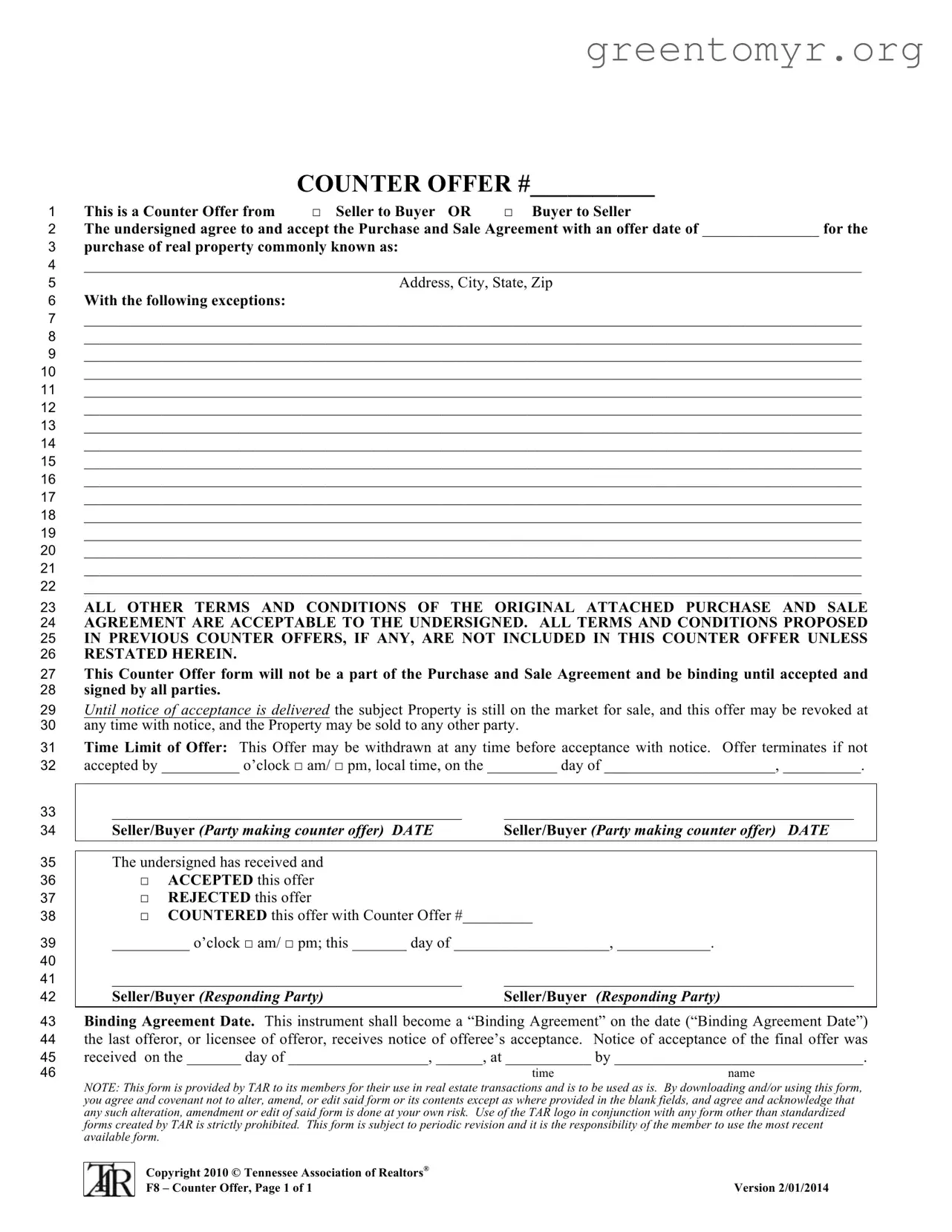
In the dynamic world of real estate transactions, effective communication between buyers and sellers is crucial, especially when it comes to negotiating terms. The Tennessee Counter Offer form serves as a vital tool in this process, allowing one party to propose modifications to an existing offer. This form can be initiated by either the seller or the buyer, and it clearly outlines the property in question, ensuring that all parties are on the same page. Key aspects of the form include the identification of exceptions to the original offer, which must be explicitly stated to avoid any confusion. Additionally, it emphasizes that all other terms and conditions of the original Purchase and Sale Agreement remain acceptable unless otherwise noted. It is important to understand that until this Counter Offer is signed and accepted by all involved parties, the property remains on the market, and the offer can be revoked at any time. The form also specifies a time limit for acceptance, ensuring that both parties remain engaged in the negotiation process. By utilizing this form thoughtfully, buyers and sellers can navigate the complexities of real estate transactions with clarity and confidence.
1
2
3
4
5
6
7
8
9
10
11
12
13
14
15
16
17
18
19
20
21
22
23
24
25
26
27
28
29
30
31
32
33
34
35
36
37
38
39
40
41
42
43
44
45
46
COUNTER OFFER #__________
This is a Counter Offer from □ Seller to Buyer OR □ Buyer to Seller
The undersigned agree to and accept the Purchase and Sale Agreement with an offer date of _______________ for the
purchase of real property commonly known as:
____________________________________________________________________________________________________
Address, City, State, Zip
With the following exceptions:
____________________________________________________________________________________________________
____________________________________________________________________________________________________
____________________________________________________________________________________________________
____________________________________________________________________________________________________
____________________________________________________________________________________________________
____________________________________________________________________________________________________
____________________________________________________________________________________________________
____________________________________________________________________________________________________
____________________________________________________________________________________________________
____________________________________________________________________________________________________
____________________________________________________________________________________________________
____________________________________________________________________________________________________
____________________________________________________________________________________________________
____________________________________________________________________________________________________
____________________________________________________________________________________________________
____________________________________________________________________________________________________
ALL OTHER TERMS AND CONDITIONS OF THE ORIGINAL ATTACHED PURCHASE AND SALE AGREEMENT ARE ACCEPTABLE TO THE UNDERSIGNED. ALL TERMS AND CONDITIONS PROPOSED IN PREVIOUS COUNTER OFFERS, IF ANY, ARE NOT INCLUDED IN THIS COUNTER OFFER UNLESS RESTATED HEREIN.
This Counter Offer form will not be a part of the Purchase and Sale Agreement and be binding until accepted and signed by all parties.
Until notice of acceptance is delivered the subject Property is still on the market for sale, and this offer may be revoked at any time with notice, and the Property may be sold to any other party.
Time Limit of Offer: This Offer may be withdrawn at any time before acceptance with notice. Offer terminates if not accepted by __________ o’clock □ am/ □ pm, local time, on the _________ day of ______________________, __________.
_____________________________________________ |
_____________________________________________ |
Seller/Buyer (Party making counter offer) DATE |
Seller/Buyer (Party making counter offer) DATE |
The undersigned has received and
□ACCEPTED this offer
□REJECTED this offer
□COUNTERED this offer with Counter Offer #_________
__________ o’clock □ am/ □ pm; this _______ day of ____________________, ____________.
_____________________________________________ |
_____________________________________________ |
Seller/Buyer (Responding Party) |
Seller/Buyer (Responding Party) |
Binding Agreement Date. This instrument shall become a “Binding Agreement” on the date (“Binding Agreement Date”) the last offeror, or licensee of offeror, receives notice of offeree’s acceptance. Notice of acceptance of the final offer was received on the _______ day of __________________, ______, at ___________ by ________________________________.
time |
name |
NOTE: This form is provided by TAR to its members for their use in real estate transactions and is to be used as is. By downloading and/or using this form, you agree and covenant not to alter, amend, or edit said form or its contents except as where provided in the blank fields, and agree and acknowledge that any such alteration, amendment or edit of said form is done at your own risk. Use of the TAR logo in conjunction with any form other than standardized forms created by TAR is strictly prohibited. This form is subject to periodic revision and it is the responsibility of the member to use the most recent available form.
Copyright 2010 © Tennessee Association of Realtors® |
|
F8 – Counter Offer, Page 1 of 1 |
Version 2/01/2014 |
| Fact Name | Description |
|---|---|
| Purpose of the Form | The Tn Counter Offer form is used to propose changes to an existing purchase and sale agreement between a buyer and a seller. |
| Binding Nature | This form becomes a binding agreement only after it is accepted and signed by all parties involved. |
| Withdrawal of Offer | The offer can be withdrawn at any time before acceptance, ensuring flexibility for the party making the counter offer. |
| Governing Law | This form is governed by Tennessee real estate laws, ensuring compliance with state regulations. |
Filling out the Tn Counter Offer form is a straightforward process. After completing the form, all parties will have a clearer understanding of the terms being proposed. This will help facilitate negotiations and ensure that everyone is on the same page regarding the sale of the property.
The TN Counter Offer form serves as a tool for either the seller or the buyer to propose changes to an existing purchase agreement. When one party wishes to modify terms, they can use this form to clearly outline their new conditions. This ensures that all parties are aware of the proposed changes and can respond accordingly.
Filling out the TN Counter Offer form involves several key steps:
Completing these steps accurately will help facilitate a smoother negotiation process.
If your counter offer is rejected, you will be notified by the other party. At this point, you may choose to revise your offer or accept the original terms of the purchase agreement. It’s important to keep communication open and consider any feedback provided by the other party to reach a mutually agreeable solution.
Yes, you can withdraw your counter offer at any time before it is accepted. To do so, you simply need to notify the other party. It’s advisable to communicate this clearly and promptly to avoid any misunderstandings.
The binding agreement date is the date when the last party receives notice of acceptance of the counter offer. This means that until all parties have signed and acknowledged the agreement, the terms are not legally binding. It is crucial for all parties to be aware of this date to understand when the agreement officially takes effect.
Yes, there are specific guidelines to follow when using the TN Counter Offer form. It must be used as provided, without alterations to its content, except for the blank fields. Additionally, using the TAR logo in conjunction with non-standard forms is prohibited. Always ensure you are using the most recent version of the form to comply with current regulations.
Filling out the TN Counter Offer form can be straightforward, but many people make common mistakes that can lead to confusion or delays. One frequent error is not clearly indicating whether the counter offer is coming from the Seller or the Buyer. This section is crucial as it sets the tone for the negotiation. If this is overlooked, it may cause misunderstandings about who is making the offer.
Another mistake often seen is leaving the address of the property incomplete. The form requires a full address, including the city, state, and zip code. Omitting any part of this information can lead to complications. Without a complete address, it may be unclear which property is being discussed, potentially causing issues in the transaction process.
Many people also fail to specify exceptions to the original agreement. This section allows parties to outline any changes or conditions that differ from the original purchase and sale agreement. If this area is left blank or filled out incorrectly, it can lead to disputes later on. It’s essential to be precise and clear about any exceptions being made.
Time limits for acceptance are another common oversight. The form includes a section where you must specify the deadline for acceptance. If this is not filled out correctly, it can create uncertainty about how long the offer stands. This could result in missed opportunities if the other party is unsure about when they need to respond.
Additionally, some individuals forget to date the counter offer. A date is necessary to establish when the offer was made. Without it, there could be confusion about the timeline of the negotiations. This can be particularly important if there are multiple offers or counter offers on the table.
Lastly, it’s important to remember that all parties must sign the form for it to be valid. Some people may assume that just filling out the form is enough. However, without signatures, the counter offer is not legally binding. Ensuring that all necessary signatures are obtained is crucial for moving forward with the transaction smoothly.
The Tennessee Counter Offer form is a crucial document in real estate transactions, allowing buyers and sellers to negotiate terms after an initial offer has been made. Alongside this form, several other documents may be used to facilitate the process. Below are four commonly associated forms that can enhance clarity and ensure all parties are informed.
Understanding these documents can help ensure a smoother transaction process. Each form serves a specific purpose and contributes to a comprehensive understanding of the real estate agreement. Being informed about these documents can empower both buyers and sellers in their negotiations.
The Tennessee Counter Offer form serves as a crucial tool in real estate negotiations, allowing parties to propose modifications to an existing offer. Several other documents share similarities with this form, each serving specific functions in the realm of real estate transactions. Here’s a look at nine documents that are comparable to the Tn Counter Offer form:
Understanding these documents can significantly enhance your ability to navigate real estate transactions effectively. Each serves a unique purpose, but all contribute to the negotiation process in their own way.
When filling out the TN Counter Offer form, it is important to follow certain guidelines to ensure clarity and compliance. Here are some key dos and don'ts:
Misconception 1: The Counter Offer form is a binding agreement.
Many people believe that submitting a Counter Offer automatically creates a binding agreement. However, this form does not become binding until all parties have accepted and signed it. Until acceptance is communicated, the property remains available for sale.
Misconception 2: All previous terms are automatically included in the Counter Offer.
Some assume that previous counter offers and their terms carry over to the new Counter Offer. In reality, only the terms explicitly restated in the new Counter Offer are considered. All other terms from prior offers are excluded unless reaffirmed.
Misconception 3: The Counter Offer cannot be revoked once submitted.
There is a common belief that once a Counter Offer is made, it cannot be taken back. This is incorrect. The Counter Offer can be revoked at any time before it is accepted, provided notice is given.
Misconception 4: The Counter Offer form is a standard document that can be altered freely.
Some individuals think they can freely modify the Counter Offer form to suit their needs. However, the form is designed to be used as is, with only specific fields available for input. Altering the content beyond these fields is done at one’s own risk and may lead to complications.
Here are some key takeaways for filling out and using the TN Counter Offer form:
Keep these points in mind to make the process smoother and more efficient for everyone involved.