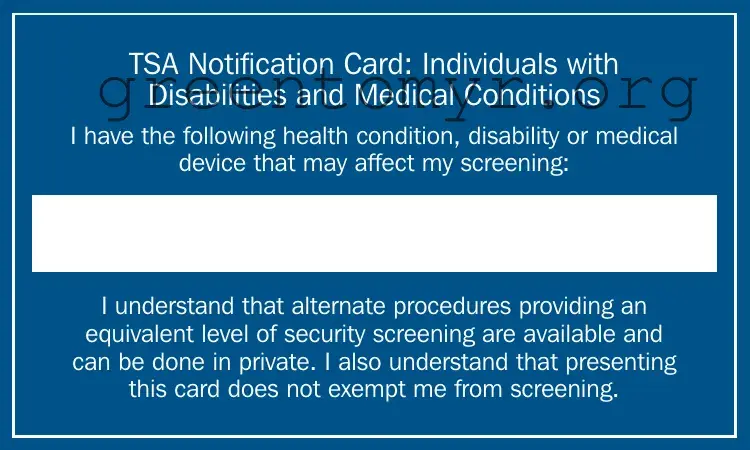
The TSA Notification Card is an essential tool designed to assist individuals with disabilities and medical conditions during the screening process at airports. This card allows travelers to communicate specific health issues or medical devices that may impact their security screening experience. By presenting this card, individuals can request alternative screening procedures that maintain a high level of security while ensuring their comfort and privacy. However, it is important to note that having the card does not exempt anyone from undergoing screening. The TSA provides various resources for travelers, including a dedicated helpline called TSA Cares, which offers support and assistance. Travelers are encouraged to reach out 72 hours before their journey to arrange for a Passenger Support Specialist at the checkpoint. If this specialist is unavailable, travelers can ask for a Supervisory TSA Officer for further assistance. The TSA aims to create a more accommodating travel experience while ensuring the safety of all passengers.

TSA Notification Card: Individuals with Disabilities and Medical Conditions
I have the following health condition, disability or medical
device that may affect my screening:
I understand that alternate procedures providing an equivalent level of security screening are available and can be done in private. I also understand that presenting this card does not exempt me from screening.

Information • Assistance Requests • Compliments • Complaints
TSA Cares
Weekdays: 8 a.m. to 11 p.m. ET
Weekends/Holidays: 9 a.m. to 8 p.m. ET
Hablamos Español
Automated information offered in 12 languages
Call 72 hours prior to traveling to request the assistance of a
Passenger Support Specialist (PSS) at the checkpoint. If a PSS is not available, you may ask for a Supervisory TSA Officer at the checkpoint.
| Fact Name | Details |
|---|---|
| Purpose | The TSA Notification Card is designed for individuals with disabilities or medical conditions that may impact their security screening process. |
| Alternate Procedures | Cardholders are informed that alternative screening procedures are available, ensuring an equivalent level of security while maintaining privacy. |
| Screening Requirement | Presenting the TSA Notification Card does not exempt individuals from undergoing security screening. |
| Contact Information | For assistance, individuals can reach out to TSA Cares at 1-855-787-2227 or via email at [email protected]. |
| Hours of Operation | TSA Cares operates weekdays from 8 a.m. to 11 p.m. ET and weekends/holidays from 9 a.m. to 8 p.m. ET. |
| Language Support | Automated information is available in 12 languages, ensuring accessibility for non-English speakers. |
| Passenger Support Specialist | Travelers are encouraged to call 72 hours in advance to request the assistance of a Passenger Support Specialist at the checkpoint. |
| Supervisor Assistance | If a Passenger Support Specialist is unavailable, individuals can ask for a Supervisory TSA Officer for help. |
| State-Specific Laws | While the TSA Notification Card is a federal form, individuals should be aware of state-specific laws regarding disabilities and medical conditions. |
To fill out the TSA Notification Card form, follow these steps carefully. This form is designed for individuals with disabilities and medical conditions who may require special assistance during the screening process. After completing the form, it is important to keep it accessible for your travel plans.
If you have any questions or need assistance, you can contact TSA Cares at 1-855-787-2227. They are available on weekdays from 8 a.m. to 11 p.m. ET and on weekends/holidays from 9 a.m. to 8 p.m. ET.
The TSA Notification Card is designed for individuals with disabilities and medical conditions. It helps inform TSA officers about specific health conditions or medical devices that may affect the screening process. While the card provides a way to communicate your needs, it does not exempt you from the screening process itself.
This card is intended for travelers who have health conditions, disabilities, or medical devices that could impact their experience during security screening. If you have a condition that requires special attention or accommodations, using this card can help facilitate a smoother process.
You can obtain a TSA Notification Card by downloading it from the TSA website or by contacting TSA Cares at 1-855-787-2227. The card is also available in various languages to accommodate diverse travelers.
If you require assistance, it is recommended to call TSA Cares at least 72 hours before your travel date. You can request the help of a Passenger Support Specialist (PSS) at the checkpoint. If a PSS is not available, you can ask for a Supervisory TSA Officer for further assistance.
Yes, the TSA offers alternative procedures that provide an equivalent level of security screening. These procedures can be conducted in private, ensuring that your privacy and comfort are respected during the screening process.
If you have a complaint or would like to share a compliment regarding your experience, you can reach out to the TSA Contact Center via email at [email protected] or by phone at 1-855-787-2227. They are available weekdays from 8 a.m. to 11 p.m. ET and weekends/holidays from 9 a.m. to 8 p.m. ET.
Absolutely. The TSA provides automated information in 12 languages. If you require assistance in a language other than English, you can request help when you call TSA Cares or at the checkpoint.
No, there is no fee associated with obtaining or using the TSA Notification Card. It is a free resource designed to assist travelers with disabilities and medical conditions during the screening process.
Filling out the TSA Notification Card can be straightforward, but mistakes can lead to delays or complications during the screening process. One common error is failing to specify the exact health condition or disability. It is essential to provide clear information about your medical needs to ensure appropriate accommodations.
Another mistake is not signing the form. A signature is necessary to validate the information provided. Without it, the card may not be accepted, and you could face additional screening procedures.
Some individuals mistakenly leave out their contact information. This can hinder communication if TSA needs to reach you regarding your request. Always include a phone number or email address where you can be easily contacted.
People often forget to check the box indicating they understand the screening process. This acknowledgment is crucial as it confirms your awareness that the card does not exempt you from screening, which is a vital part of airport security.
Another frequent error involves not notifying TSA at least 72 hours in advance if you require the assistance of a Passenger Support Specialist. This advance notice is necessary for TSA to arrange appropriate support during your travel.
Some travelers also assume that presenting the card guarantees expedited screening. This is not the case. The card helps communicate your needs but does not change the screening requirements.
Individuals sometimes provide incomplete information regarding their medical devices. It is important to include all relevant details about devices that may require special handling during the screening process.
Another mistake is not bringing the card to the airport. Even if you filled it out correctly, leaving it at home means you will not have the necessary documentation to communicate your needs during screening.
People may also misunderstand the purpose of the card. It is intended to assist in communication with TSA personnel, not to bypass security protocols. Clarity on this point is essential to avoid confusion at the checkpoint.
Lastly, some travelers fail to ask for help when needed. If you encounter difficulties during the screening process, do not hesitate to request assistance from TSA staff. They are trained to help individuals with disabilities and medical conditions.
The TSA Notification Card is an important document for individuals with disabilities or medical conditions, ensuring they receive appropriate screening accommodations at airports. However, there are several other forms and documents that may be necessary to facilitate a smooth travel experience. Below is a list of commonly used forms alongside the TSA Notification Card.
Being prepared with these additional documents can greatly enhance the travel experience for individuals with disabilities or medical conditions. It is always advisable to plan ahead and communicate specific needs to ensure a smooth and accommodating journey through airport security.
The TSA Notification Card is an important tool for individuals with disabilities and medical conditions, helping to ensure a smoother travel experience. Several other documents serve similar purposes in providing necessary information and support during travel. Here are four documents that share similarities with the TSA Notification Card:
Each of these documents plays a vital role in enhancing the travel experience for individuals with unique needs, ensuring that they receive the support and understanding they deserve.
When filling out the TSA Notification Card form, keep these important dos and don'ts in mind:
Understanding the TSA Notification Card is crucial for travelers with disabilities and medical conditions. However, several misconceptions often arise regarding its purpose and use. Here are eight common misunderstandings:
Being informed about these misconceptions can help travelers better navigate the security screening process while ensuring their rights and needs are respected.
When filling out and using the TSA Notification Card form, here are some key takeaways to keep in mind:
Remember, being prepared and informed can make your travel experience smoother and more comfortable.