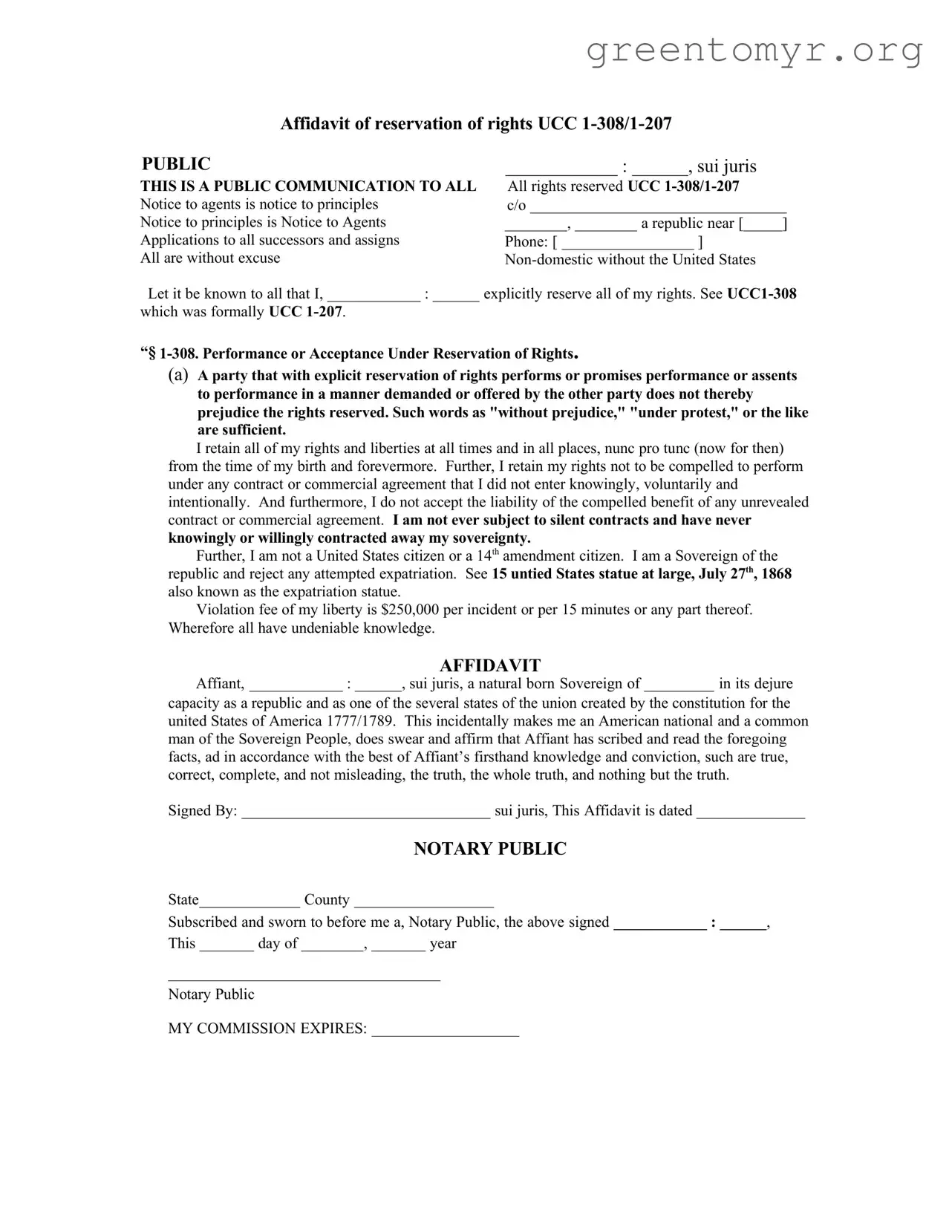
The UCC 1-308 form, often referred to as the Affidavit of Reservation of Rights, serves as a powerful tool for individuals wishing to assert their rights in a legal context. This form allows a person to explicitly reserve their rights when entering into agreements or contracts, ensuring that they do not unintentionally waive any legal protections. By invoking UCC 1-308, individuals can communicate their intent to perform under a reservation of rights, which means they can accept performance or fulfill obligations without compromising their legal standing. The form also emphasizes the importance of notifying all parties involved, as it states that notice to agents is notice to principals, and vice versa. This public declaration aims to prevent misunderstandings about one's legal status and rights. Notably, the UCC 1-308 form includes provisions that assert a person's sovereignty and their rejection of any involuntary citizenship claims. It outlines the consequences of violating these rights, establishing a clear stance against any attempts to impose silent contracts. Overall, the UCC 1-308 form is a significant document for those who wish to maintain control over their legal identity and protect their rights in various transactions.
Affidavit of reservation of rights UCC
PUBLIC
THIS IS A PUBLIC COMMUNICATION TO ALL Notice to agents is notice to principles
Notice to principles is Notice to Agents Applications to all successors and assigns All are without excuse
____________ : ______, sui juris
All rights reserved UCC
c/o _________________________________
________, ________ a republic near [_____]
Phone: [ _________________ ]
Let it be known to all that I, ____________ : ______ explicitly reserve all of my rights. See
which was formally UCC
Ҥ
(a)A party that with explicit reservation of rights performs or promises performance or assents to performance in a manner demanded or offered by the other party does not thereby prejudice the rights reserved. Such words as "without prejudice," "under protest," or the like are sufficient.
I retain all of my rights and liberties at all times and in all places, nunc pro tunc (now for then) from the time of my birth and forevermore. Further, I retain my rights not to be compelled to perform under any contract or commercial agreement that I did not enter knowingly, voluntarily and intentionally. And furthermore, I do not accept the liability of the compelled benefit of any unrevealed contract or commercial agreement. I am not ever subject to silent contracts and have never knowingly or willingly contracted away my sovereignty.
Further, I am not a United States citizen or a 14th amendment citizen. I am a Sovereign of the republic and reject any attempted expatriation. See 15 untied States statue at large, July 27th, 1868 also known as the expatriation statue.
Violation fee of my liberty is $250,000 per incident or per 15 minutes or any part thereof. Wherefore all have undeniable knowledge.
AFFIDAVIT
Affiant, ____________ : ______, sui juris, a natural born Sovereign of _________ in its dejure
capacity as a republic and as one of the several states of the union created by the constitution for the united States of America 1777/1789. This incidentally makes me an American national and a common man of the Sovereign People, does swear and affirm that Affiant has scribed and read the foregoing facts, ad in accordance with the best of Affiant’s firsthand knowledge and conviction, such are true, correct, complete, and not misleading, the truth, the whole truth, and nothing but the truth.
Signed By: ________________________________ sui juris, This Affidavit is dated ______________
NOTARY PUBLIC
State_____________ County __________________
Subscribed and sworn to before me a, Notary Public, the above signed ____________ : ______,
This _______ day of ________, _______ year
___________________________________
Notary Public
MY COMMISSION EXPIRES: ___________________
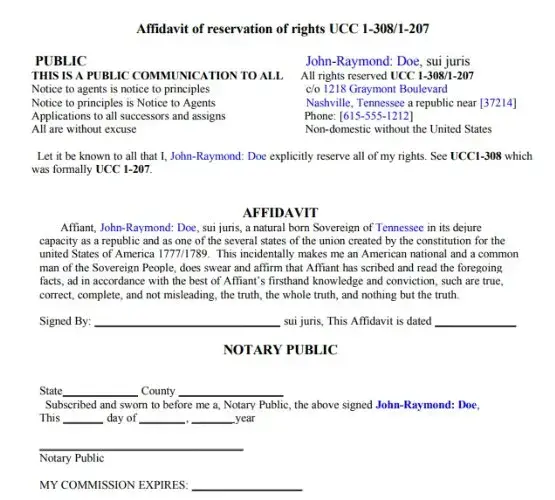
FILLED OUT EXAMPLE
Affidavit of reservation of rights UCC
PUBLIC |
|
THIS IS A PUBLIC COMM UNICATION TO ALL |
All rights reserved UCC |
Notice to agents is notice to principles |
c/o 1218 Graymont Boulevard |
Notice to principles is Notice to Agents |
Nashville, Tennessee a republic near (372 14] |
Applications to all successors and as.signs |
Phone: [6 |
All are without excuse |
Let it be known to all that I,
AFFIDAVIT
Affiant.
capacity as a republic and as one of the several states of the union created by the constitution for the united States of America 1777/1 789. This incidentally makes me an American national and a common man of the Sovereign People, does swear and affirm that Affiant has scribed and read the fo regoing
facts. ad in accordance with the best ofAffiant's firsthand knowledge and conviction. such arc true,
correc~ complete, and not misleading, the truth, the whole truth, and nothing but the truth.
Signed By: _____________ sui juris, This Affidavit is dated ______
NOTARY PUBLIC
State______ County ________
Subscribed and sworn to before me a, Notary Public, the above
Notary Public
MY COMMISSION EXPIRES: _______
| Fact Name | Details |
|---|---|
| Purpose | The UCC 1-308 form is used to reserve rights in legal agreements, ensuring that a party does not waive their rights by performing under protest. |
| Legal Basis | This form is grounded in the Uniform Commercial Code (UCC), specifically UCC § 1-308, which addresses performance under reservation of rights. |
| State Variations | Different states may have specific variations or requirements for the UCC 1-308 form, reflecting local laws and practices. |
| Affidavit Component | The form includes an affidavit section, where the individual swears to the truthfulness of the information provided, affirming their status as a sovereign entity. |
| Non-Domestic Status | Individuals using this form often declare themselves as non-domestic entities, distancing themselves from U.S. citizenship and its implications. |
| Reservation of Rights | The form explicitly states that all rights are reserved, which means that the individual does not consent to any agreements that may infringe upon their rights. |
| Liability Clauses | The form includes clauses that outline the individual's refusal to accept liability for any undisclosed contracts or agreements. |
| Expatriation Reference | It references the expatriation statute, asserting the individual's claim to sovereignty and rejecting any attempts to classify them as a U.S. citizen under the 14th Amendment. |
Filling out the UCC 1-308 form is an important step in formally reserving your rights. After completing the form, you will need to submit it to the appropriate filing office in your jurisdiction. Ensure that all information is accurate and complete to avoid any potential issues.
The UCC 1-308 form is an affidavit that serves as a public declaration of an individual's intention to reserve their rights under the Uniform Commercial Code (UCC). It is often used to assert that the signer does not waive any rights or privileges by engaging in transactions or agreements.
"Sui juris" is a Latin term meaning "of one's own right." In the context of the UCC 1-308 form, it indicates that the individual signing the affidavit is acting in their own capacity and asserts their rights without external influence or coercion.
This form is important because it allows individuals to explicitly reserve their rights in legal and commercial transactions. By filing this affidavit, a person can protect themselves from being bound by agreements or contracts they did not willingly enter into.
Reserving rights under UCC 1-308 means that a party can perform or agree to perform under a contract while still maintaining their legal rights. This can prevent the loss of rights due to acceptance of terms that may not be fully understood or agreed upon.
Any individual who wishes to assert their rights in a legal or commercial context can use the UCC 1-308 form. This includes those who identify as sovereign citizens or individuals who want to clarify their legal standing.
Filing a UCC 1-308 form may lead to increased scrutiny in legal matters. It can also provoke responses from entities that may challenge the assertions made in the affidavit. It is advisable to understand the implications fully before filing.
To complete the UCC 1-308 form, an individual must fill in their name, address, and other personal details. They must also declare their intention to reserve rights explicitly and sign the affidavit in the presence of a notary public to validate the document.
Yes, a notary public is required to witness the signing of the UCC 1-308 form. This adds a layer of authenticity and legal recognition to the affidavit, ensuring that it is properly executed.
Yes, the UCC 1-308 form can be challenged in court or by other parties. Its effectiveness may depend on the context in which it is used and the willingness of other parties to acknowledge its assertions.
Filling out the UCC 1-308 form can be a straightforward process, but many people make common mistakes that can lead to complications. One significant error is failing to provide complete personal information. The form requires the affiant's name and address, yet some individuals leave out critical details. Omitting this information can cause delays in processing or even invalidate the form.
Another mistake is misunderstanding the purpose of the form. The UCC 1-308 is meant to reserve rights, yet some people incorrectly believe it serves as a blanket protection against all legal obligations. This misconception can lead to unrealistic expectations about the form's effectiveness and may result in unintended legal consequences.
Inaccurate or incomplete signatures are also a frequent issue. The form must be signed by the affiant, and any discrepancies in the name or title can create problems. It's essential to ensure that the signature matches the name as it appears elsewhere on the form. A mismatch could raise questions about the validity of the affidavit.
Many individuals also fail to have the document notarized correctly. Notarization is a critical step in verifying the identity of the signer and the authenticity of the document. Neglecting this step or using an unqualified notary can lead to the rejection of the form. Always check that the notary's commission is valid and that they are authorized to perform notarizations in your state.
People sometimes overlook the importance of the date on the form. The affidavit must be dated correctly to establish a clear timeline of events. An incorrect or missing date can create confusion regarding the validity of the reservation of rights and may complicate future legal proceedings.
Lastly, many individuals do not fully understand the implications of the language used in the form. Phrases like "without prejudice" or "under protest" are crucial for reserving rights, yet some people either misuse them or fail to include them altogether. This oversight can diminish the effectiveness of the affidavit, potentially undermining the protections it aims to provide.
The UCC 1-308 form is often used in conjunction with several other documents to ensure that individuals can effectively assert their rights and maintain their sovereignty. Below is a list of these forms and documents, along with brief descriptions of each.
These documents, when used alongside the UCC 1-308 form, can help individuals assert their rights and navigate legal matters more effectively. It is essential to understand the purpose and implications of each document to ensure that one’s interests are adequately protected.
The UCC 1-308 form, also known as the Affidavit of Reservation of Rights, serves a specific purpose in asserting one's rights under the Uniform Commercial Code. There are several other documents that share similarities with this form in terms of their intent and function. Below are eight such documents, each with a brief explanation of how they relate to the UCC 1-308 form.
When filling out the UCC 1-308 form, it's important to follow specific guidelines to ensure accuracy and compliance. Here are ten things you should and shouldn't do:
Understanding the UCC 1-308 form is essential for anyone considering its use. However, several misconceptions can lead to confusion. Here are six common misunderstandings:
Clarifying these misconceptions can help individuals make informed decisions regarding the use of the UCC 1-308 form.
The UCC 1-308 form is an important document for individuals wishing to reserve their rights in various legal situations. Here are key takeaways regarding its use:
Completing the UCC 1-308 form accurately is essential for ensuring that rights are protected and clearly communicated. Proper use of this form can help individuals assert their sovereignty and legal standing.