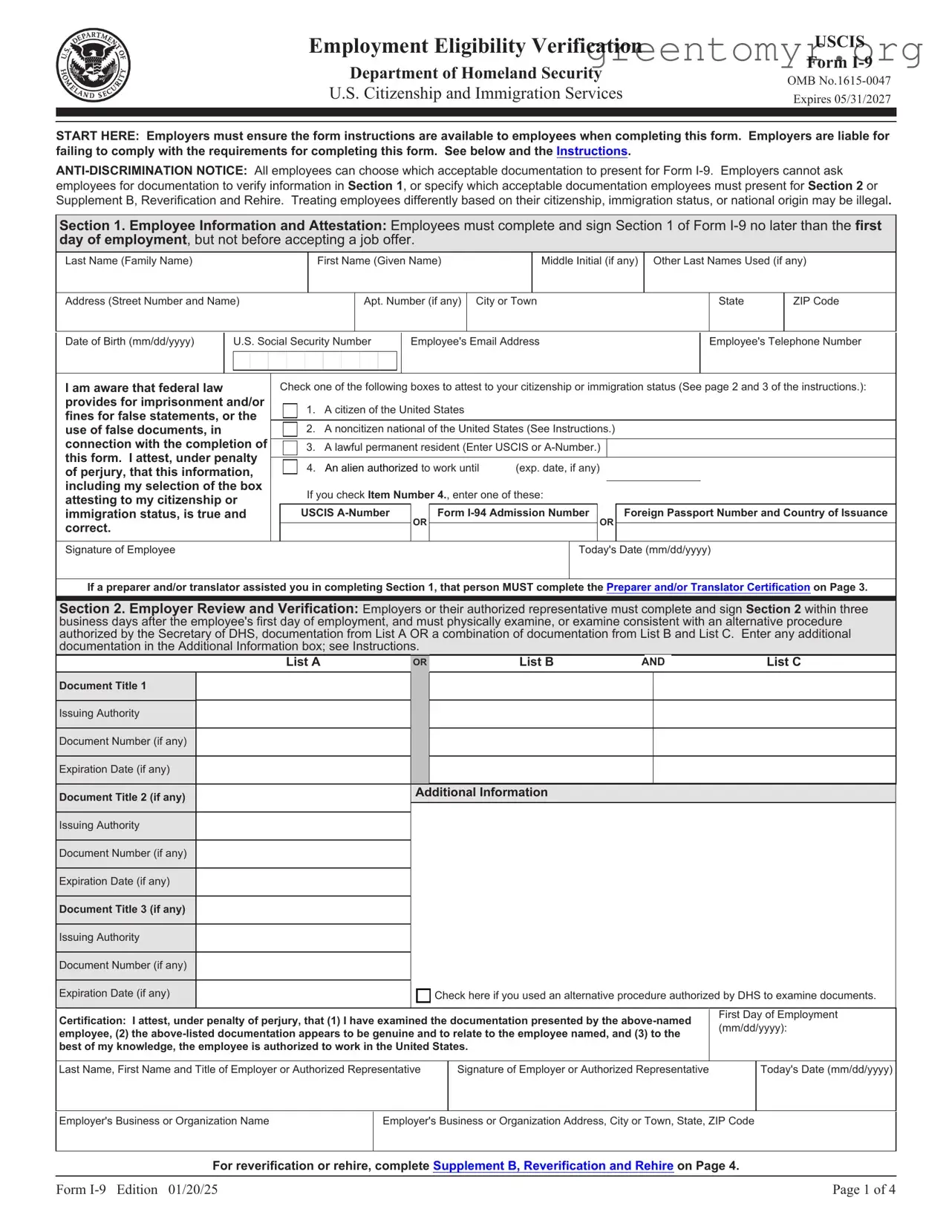
The USCIS I-9 form is a crucial document for both employers and employees in the United States, serving as a means to verify an individual's identity and employment eligibility. This form is required by law for all employers to complete when hiring new employees, regardless of their citizenship status. The I-9 consists of three main sections: the employee's information, the employer's review of documents, and the employer's certification. In the first section, employees provide their personal details, including name, address, and date of birth, while also declaring their citizenship or immigration status. Employers must then review acceptable documents presented by the employee that establish identity and employment authorization. This could include a U.S. passport, a permanent resident card, or a combination of other documents. Finally, the employer certifies the information by signing the form, ensuring compliance with federal regulations. Accurate completion of the I-9 form is essential, as failure to comply can lead to significant penalties for employers, including fines and potential legal issues. Understanding the nuances of the I-9 process is vital for anyone involved in hiring practices in the U.S.
|
Employment Eligibility Verification |
USCIS |
|
|
Department of Homeland Security |
Form |
|
|
OMB |
|
|
|
U.S. Citizenship and Immigration Services |
|
|
|
Expires 05/31/2027 |
|
|
|
|
|
|
|
|
|
|
START HERE: Employers must ensure the form instructions are available to employees when completing this form. Employers are liable for failing to comply with the requirements for completing this form. See below and the Instructions.
Section 1. Employee Information and Attestation: Employees must complete and sign Section 1 of Form
Last Name (Family Name)
First Name (Given Name)
Middle Initial (if any)
Other Last Names Used (if any)
Address (Street Number and Name)
Apt. Number (if any)
City or Town
State
ZIP Code
Date of Birth (mm/dd/yyyy)
U.S. Social Security Number
Employee's Email Address
Employee's Telephone Number
I am aware that federal law |
|
Check one of the following boxes to attest to your citizenship or immigration status (See page 2 and 3 of the instructions.): |
|||||||||
provides for imprisonment and/or |
|
1. A citizen of the United States |
|
|
|
|
|
|
|||
fines for false statements, or the |
|
|
|
|
|
|
|
||||
|
|
|
|
|
|
|
|
|
|
|
|
use of false documents, in |
|
2. A noncitizen national of the United States (See Instructions.) |
|||||||||
connection with the completion of |
3. |
A lawful permanent resident (Enter USCIS or |
|
|
|
||||||
this form. I attest, under penalty |
|
|
|
|
|
|
|
|
|
|
|
4. |
An alien authorized to work until |
(exp. date, if any) |
|
|
|
|
|||||
of perjury, that this information, |
|
|
|
|
|||||||
including my selection of the box |
|
If you check Item Number 4., enter one of these: |
|
|
|
|
|||||
attesting to my citizenship or |
|
|
|
|
|
||||||
immigration status, is true and |
|
USCIS |
OR |
Form |
OR |
Foreign Passport Number and Country of Issuance |
|||||
correct. |
|
|
|
|
|
|
|
||||
|
|
|
|
|
|
|
|
|
|
|
|
|
|
|
|
|
|
|
|
|
|
|
|
Signature of Employee |
|
|
|
|
|
|
Today's Date (mm/dd/yyyy) |
||||
|
|
|
|
|
|
|
|
|
|
|
|
If a preparer and/or translator assisted you in completing Section 1, that person MUST complete the Preparer and/or Translator Certification on Page 3.
Section 2. Employer Review and Verification: Employers or their authorized representative must complete and sign Section 2 within three business days after the employee's first day of employment, and must physically examine, or examine consistent with an alternative procedure authorized by the Secretary of DHS, documentation from List A OR a combination of documentation from List B and List C. Enter any additional documentation in the Additional Information box; see Instructions.
|
List A |
OR |
List B |
|
AND |
List C |
|
Document Title 1 |
|
|
|
|
|
|
|
|
|
|
|
|
|
|
|
Issuing Authority |
|
|
|
|
|
|
|
|
|
|
|
|
|
|
|
Document Number (if any) |
|
|
|
|
|
|
|
|
|
|
|
|
|
|
|
Expiration Date (if any) |
|
|
|
|
|
|
|
|
|
|
|
|
|
|
|
Document Title 2 (if any) |
|
|
Additional Information |
|
|
|
|
|
|
|
|
|
|
|
|
Issuing Authority |
|
|
|
|
|
|
|
|
|
|
|
|
|
|
|
Document Number (if any) |
|
|
|
|
|
|
|
|
|
|
|
|
|
|
|
Expiration Date (if any) |
|
|
|
|
|
|
|
|
|
|
|
|
|
|
|
Document Title 3 (if any) |
|
|
|
|
|
|
|
|
|
|
|
|
|
|
|
Issuing Authority |
|
|
|
|
|
|
|
|
|
|
|
|
|
|
|
Document Number (if any) |
|
|
|
|
|
|
|
|
|
|
|
||||
Expiration Date (if any) |
|
|
Check here if you used an alternative procedure authorized by DHS to examine documents. |
||||
|
|
|
|
|
|
|
|
Certification: I attest, under penalty of perjury, that (1) I have examined the documentation presented by the
First Day of Employment (mm/dd/yyyy):
Last Name, First Name and Title of Employer or Authorized Representative |
Signature of Employer or Authorized Representative |
Today's Date (mm/dd/yyyy) |
|
|
|
|
|
Employer's Business or Organization Name |
Employer's Business or Organization Address, City or Town, State, ZIP Code |
|
|
|
|
|
|
For reverification or rehire, complete Supplement B, Reverification and Rehire on Page 4.
Form |
Page 1 of 4 |

LISTS OF ACCEPTABLE DOCUMENTS
All documents containing an expiration date must be unexpired.
* Documents extended by the issuing authority are considered unexpired.
Employees may present one selection from List A or a
combination of one selection from List B and one selection from List C.
Examples of many of these documents appear in the Handbook for Employers
|
|
LIST A |
|
|
LIST B |
|
|
|
|
LIST C |
Documents that Establish Both Identity |
OR |
|
Documents that Establish Identity |
AND |
Documents that Establish Employment |
|||||
|
and Employment Authorization |
|
|
Authorization |
||||||
|
|
|
|
|
|
|
|
|||
1. |
U.S. Passport or U.S. Passport Card |
|
1. Driver's license or ID card issued by a State or |
|
1. A Social Security Account Number card, |
|||||
|
|
unless the card includes one of the following |
||||||||
|
|
|
|
|
outlying possession of the United States |
|
|
|||
2. |
Permanent Resident Card or Alien |
|
|
|
|
restrictions: |
||||
|
|
provided it contains a photograph or |
|
|
||||||
|
|
|
|
|
|
|
||||
|
Registration Receipt Card (Form |
|
|
information such as name, date of birth, |
|
|
|
(1) |
NOT VALID FOR EMPLOYMENT |
|
|
|
|
|
|
sex, height, eye color, and address |
|
|
|
(2) |
|
3. |
Foreign passport that contains a |
|
|
|
|
|
VALID FOR WORK ONLY WITH |
|||
|
|
|
|
|
|
|||||
|
temporary |
|
|
|
|
|
|
|
INS AUTHORIZATION |
|
|
|
2. ID card issued by federal, state or local |
|
|
|
|
||||
|
|
|
|
|
|
|
||||
|
|
|
government agencies or entities, provided it |
|
|
(3) |
VALID FOR WORK ONLY WITH |
|||
|
readable immigrant visa |
|
|
|
|
|||||
|
|
|
contains a photograph or information such as |
|
|
|
DHS AUTHORIZATION |
|||
|
|
|
|
|
|
|
|
|||
4. |
Employment Authorization Document |
|
|
name, date of birth, sex, height, eye color, |
|
|
|
|
|
|
|
|
and address |
|
|
|
|
|
|||
|
that contains a photograph (Form |
|
|
|
2. |
Certification of report of birth issued by the |
||||
|
|
|
|
|
||||||
|
|
|
|
3. School ID card with a photograph |
|
|
|
Department of State (Forms |
||
5. For an individual temporarily authorized |
|
|
|
|
||||||
|
|
|
|
|||||||
|
|
|
|
|
|
|||||
|
to work for a specific employer because |
|
|
|
|
|
|
|||
|
|
4. |
Voter's registration card |
|
|
|
|
|
||
|
of his or her status or parole: |
|
|
3. |
Original or certified copy of birth certificate |
|||||
|
|
|
|
|
||||||
|
|
|
|
|
|
|
|
|
issued by a State, county, municipal |
|
|
a. Foreign passport; and |
|
5. |
U.S. Military card or draft record |
|
|
|
|||
|
|
|
|
|
authority, or territory of the United States |
|||||
|
b. Form |
|
6. |
Military dependent's ID card |
|
|
|
bearing an official seal |
||
|
the following: |
|
|
|
|
|
4. Native American tribal document |
|||
|
|
7. U.S. Coast Guard Merchant Mariner Card |
|
|
||||||
|
|
|
|
|
|
|||||
|
(1) |
The same name as the |
|
|
|
|
|
|
||
|
|
|
|
|
|
5. U.S. Citizen ID Card (Form |
||||
|
(2) |
passport; and |
|
8. |
Native American tribal document |
|
|
|||
|
|
|
|
|
|
|
||||
|
An endorsement of the |
|
|
|
|
6. |
Identification Card for Use of Resident |
|||
|
|
9. |
Driver's license issued by a Canadian |
|
||||||
|
|
individual's status or parole as |
|
|
|
|
Citizen in the United States (Form |
|||
|
|
long as that period of |
|
|
government authority |
|
|
|
|
|
|
|
|
|
|
|
|
|
|
||
|
|
endorsement has not yet |
|
|
|
|
7. |
Employment authorization document |
||
|
|
|
For persons under age 18 who are |
|||||||
|
|
expired and the proposed |
|
|
|
issued by the Department of Homeland |
||||
|
|
employment is not in conflict |
|
|
unable to present a document |
|
|
|
Security |
|
|
|
with any restrictions or |
|
|
listed above: |
|
|
|
For examples, see Section 7 and |
|
|
|
limitations identified on the form. |
|
|
|
|
|
|
||
|
|
|
10. |
School record or report card |
|
|
|
Section 13 of the |
||
|
|
|
|
|
|
|
||||
6. Passport from the Federated States of |
|
|
|
|
|
|
||||
|
11. |
Clinic, doctor, or hospital record |
|
|
|
|||||
|
Micronesia (FSM) or the Republic of the |
|
|
|
|
The Form |
||||
|
Marshall Islands (RMI) with Form |
|
|
|
|
|
|
|||
|
|
12. |
|
|
|
Authorization Document, is a List A, Item |
||||
|
Form |
|
|
|
|
Number 4. document, not a List C |
||||
|
admission under the Compact of Free |
|
|
|
|
|
|
document. |
||
|
Association Between the United States |
|
|
|
|
|
|
|||
|
|
|
|
|
|
|
|
|
||
|
and the FSM or RMI |
|
|
|
|
|
|
|
|
|
|
|
|
|
|
|
|
|
|
|
|
Acceptable Receipts
May be presented in lieu of a document listed above for a temporary period.
For receipt validity dates, see the
●Receipt for a replacement of a lost, stolen, or damaged List A document.
●Form
●Form
OR
Receipt for a replacement of a lost, stolen, or damaged List B document.
Receipt for a replacement of a lost, stolen, or damaged List C document.
*Refer to the Employment Authorization Extensions page on
Form |
Page 2 of 4 |
Supplement A, |
USCIS |
Preparer and/or Translator Certification for Section 1 |
Form |
Department of Homeland Security |
Supplement A |
OMB No. |
|
U.S. Citizenship and Immigration Services |
Expires 05/31/2027 |
Last Name (Family Name) from Section 1.
First Name (Given Name) from Section 1.
Middle initial (if any) from Section 1.
Instructions: This supplement must be completed by any preparer and/or translator who assists an employee in completing Section 1 of Form
I attest, under penalty of perjury, that I have assisted in the completion of Section 1 of this form and that to the best of my knowledge the information is true and correct.
Signature of Preparer or Translator |
|
|
Date (mm/dd/yyyy) |
|
|
|
|
|
|
|
|
Last Name (Family Name) |
First Name (Given Name) |
|
|
Middle Initial (if any) |
|
|
|
|
|
|
|
Address (Street Number and Name) |
|
City or Town |
|
State |
ZIP Code |
|
|
|
|
|
|
I attest, under penalty of perjury, that I have assisted in the completion of Section 1 of this form and that to the best of my knowledge the information is true and correct.
Signature of Preparer or Translator
Date (mm/dd/yyyy)
Last Name (Family Name)
First Name (Given Name)
Middle Initial (if any)
Address (Street Number and Name)
City or Town
State
ZIP Code
I attest, under penalty of perjury, that I have assisted in the completion of Section 1 of this form and that to the best of my knowledge the information is true and correct.
Signature of Preparer or Translator
Date (mm/dd/yyyy)
Last Name (Family Name)
First Name (Given Name)
Middle Initial (if any)
Address (Street Number and Name)
City or Town
State
ZIP Code
I attest, under penalty of perjury, that I have assisted in the completion of Section 1 of this form and that to the best of my knowledge the information is true and correct.
Signature of Preparer or Translator
Date (mm/dd/yyyy)
Last Name (Family Name)
First Name (Given Name)
Middle Initial (if any)
Address (Street Number and Name)
City or Town
State
ZIP Code
Form |
Page 3 of 4 |
Supplement B, |
USCIS |
Reverification and Rehire (formerly Section 3) |
Form |
Department of Homeland Security |
Supplement B |
OMB No. |
|
U.S. Citizenship and Immigration Services |
Expires 05/31/2027 |
Last Name (Family Name) from Section 1.
First Name (Given Name) from Section 1.
Middle initial (if any) from Section 1.
Instructions: This supplement replaces Section 3 on the previous version of Form
Handbook for Employers: Guidance for Completing Form
Date of Rehire (if applicable) |
New Name (if applicable) |
|
|
Date (mm/dd/yyyy) |
Last Name (Family Name) |
First Name (Given Name) |
Middle Initial |
|
|
|
|
Reverification: If the employee requires reverification, your employee can choose to present any acceptable List A or List C documentation to show |
|||||||
continued employment authorization. Enter the document information in the spaces below. |
|
|
|
||||
|
|
|
|
|
|
|
|
Document Title |
|
|
Document Number (if any) |
Expiration Date (if any) (mm/dd/yyyy) |
|||
|
|
|
|
|
|
|
|
I attest, under penalty of perjury, that to the best of my knowledge, this employee is authorized to work in the United States, and if the |
|||||||
employee presented documentation, the documentation I examined appears to be genuine and to relate to the individual who presented it. |
|||||||
|
|
|
|
|
|
|
|
Name of Employer or Authorized Representative |
|
Signature of Employer or Authorized Representative |
|
Today's Date (mm/dd/yyyy) |
|||
|
|
|
|
|
|
|
|
Additional Information (Initial and date each notation.) |
|
|
|
|
Check here if you used an |
||
|
|
|
|
|
|
alternative procedure authorized |
|
|
|
|
|
|
|
by DHS to examine documents. |
|
|
|
|
|
|
|
|
|
|
|
|
|
|
|
|
|
Date of Rehire (if applicable) |
New Name (if applicable) |
|
|
|
|
|
|
Date (mm/dd/yyyy) |
Last Name (Family Name) |
|
|
First Name (Given Name) |
|
|
Middle Initial |
|
|
|
|
|
|
|
|
Reverification: If the employee requires reverification, your employee can choose to present any acceptable List A or List C documentation to show |
|||||||
continued employment authorization. Enter the document information in the spaces below. |
|
|
|
||||
Document Title |
|
|
Document Number (if any) |
Expiration Date (if any) (mm/dd/yyyy) |
|||
|
|
|
|
|
|
||
I attest, under penalty of perjury, that to the best of my knowledge, this employee is authorized to work in the United States, and if the |
|||||||
employee presented documentation, the documentation I examined appears to be genuine and to relate to the individual who presented it. |
|||||||
|
|
|
|
|
|
|
|
Name of Employer or Authorized Representative |
|
Signature of Employer or Authorized Representative |
|
Today's Date (mm/dd/yyyy) |
|||
|
|
|
|
|
|
|
|
Additional Information (Initial and date each notation.) |
|
|
|
|
Check here if you used an |
||
|
|
|
|
|
|
||
|
|
|
|
|
|
alternative procedure authorized |
|
|
|
|
|
|
|
by DHS to examine documents. |
|
|
|
|
|
|
|
|
|
|
|
|
|
|
|
|
|
Date of Rehire (if applicable) |
New Name (if applicable) |
|
|
|
|
|
|
Date (mm/dd/yyyy) |
Last Name (Family Name) |
|
|
First Name (Given Name) |
|
|
Middle Initial |
|
|
|
|
|
|
|
|
Reverification: If the employee requires reverification, your employee can choose to present any acceptable List A or List C documentation to show |
|||||||
continued employment authorization. Enter the document information in the spaces below. |
|
|
|
||||
Document Title |
|
|
Document Number (if any) |
Expiration Date (if any) (mm/dd/yyyy) |
|||
|
|
|
|
|
|
|
|
I attest, under penalty of perjury, that to the best of my knowledge, this employee is authorized to work in the United States, and if the |
|||||||
employee presented documentation, the documentation I examined appears to be genuine and to relate to the individual who presented it. |
|||||||
|
|
|
|
|
|||
Name of Employer or Authorized Representative |
|
Signature of Employer or Authorized Representative |
|
Today's Date (mm/dd/yyyy) |
|||
|
|
|
|
|
|
|
|
Additional Information (Initial and date each notation.) |
|
|
|
|
Check here if you used an |
||
|
|
|
|
|
|
||
|
|
|
|
|
|
alternative procedure authorized |
|
|
|
|
|
|
|
by DHS to examine documents. |
|
|
|
|
|
|
|
|
|
|
|
|
|
|
|
|
|
Form |
Page 4 of 4 |
| Fact Name | Description |
|---|---|
| Purpose | The I-9 form is used to verify the identity and employment authorization of individuals hired for employment in the United States. |
| Who Must Complete | All employers must ensure that the I-9 form is completed for every employee hired after November 6, 1986. |
| Completion Timeline | Employees must complete Section 1 of the I-9 form on or before their first day of work. |
| Employer Responsibilities | Employers must complete Section 2 of the I-9 form within three business days of the employee's start date. |
| Document Requirements | Employees must present valid documents that establish both identity and employment authorization. |
| Retention Period | Employers must retain the completed I-9 form for three years after the date of hire or one year after employment ends, whichever is longer. |
| State-Specific Forms | Some states have additional requirements. For example, California requires employers to provide a notice of the employee's rights under state law. |
| Penalties for Non-Compliance | Employers can face civil penalties for failing to properly complete or retain the I-9 form. |
| Electronic I-9 | Employers may use electronic systems to complete and store I-9 forms, provided they comply with federal regulations. |
| Updates | The I-9 form is subject to updates. Employers should always use the most current version available from USCIS. |
Completing the USCIS I-9 form is a crucial step for employers and employees. This form verifies the identity and employment authorization of individuals hired for work in the United States. Follow these steps to accurately fill out the form.
After filling out the form, ensure that all information is accurate. Keep the form on file for the required retention period, which is typically three years after the hire date or one year after the employee's termination, whichever is later.
The USCIS I-9 form, officially known as the Employment Eligibility Verification form, is a document that employers in the United States must complete for every new employee. This form helps verify the identity and employment authorization of individuals hired for work in the U.S. Both the employer and the employee must fill out sections of the form, ensuring compliance with federal law.
All employers in the U.S. must complete the I-9 form for every employee they hire. This requirement applies to citizens, non-citizens, and lawful permanent residents. Additionally, employees must provide acceptable documentation that proves their identity and eligibility to work in the U.S.
Employees must present documents that fall into three categories:
Employees can choose to present one document from List A or one document from List B and one from List C.
The I-9 form must be completed within three days of the employee's start date. Employers should ensure that the employee fills out their section of the form on or before their first day of work. The employer must then complete their section of the form within the three-day window.
Employers must retain the completed I-9 form for three years after the date of hire or for one year after the employee's termination, whichever is longer. It's important to keep the forms in a secure location, as they may be subject to inspection by government officials.
Failure to comply with I-9 requirements can lead to significant penalties. Employers may face fines ranging from hundreds to thousands of dollars for each violation. Additionally, knowingly hiring or continuing to employ individuals who are not authorized to work can result in more severe penalties, including criminal charges in certain cases.
The I-9 form can be downloaded for free from the U.S. Citizenship and Immigration Services (USCIS) website. It's essential to use the most current version of the form to ensure compliance with regulations. Employers should also check for any updates or changes to the form regularly.
Filling out the USCIS I-9 form is a crucial step for both employers and employees in the United States. However, many people make common mistakes that can lead to delays or complications. Understanding these pitfalls can help ensure a smoother process.
One frequent error is failing to complete the form within the required timeframe. Employers must ensure that the I-9 is filled out within three days of an employee's start date. If this deadline is missed, it can result in penalties.
Another mistake involves incorrect information. Many individuals accidentally enter wrong names, Social Security numbers, or dates. Such inaccuracies can cause issues during verification and may lead to the rejection of the form.
Some people overlook the importance of signing and dating the form. Both the employee and the employer must sign the I-9 to confirm that the information provided is accurate. An unsigned form is incomplete and invalid.
Additionally, individuals sometimes fail to provide the necessary documentation to verify their identity and employment eligibility. The I-9 requires specific documents, and not presenting the correct ones can result in an inability to complete the form properly.
Using outdated versions of the form is another common mistake. The USCIS periodically updates the I-9 form, and using an old version can lead to compliance issues. Always check for the most current version before filling it out.
Some people neglect to read the instructions thoroughly. The I-9 form comes with guidelines that clarify how to fill it out correctly. Skipping these instructions can lead to misunderstandings and errors.
Another issue arises when employees fail to provide their documentation in a timely manner. If an employee does not present their documents within the three-day window, the employer cannot complete the I-9 process.
Finally, many individuals do not keep copies of the completed I-9 form. Employers are required to retain these forms for a specific period. Not having a copy can complicate future audits or inquiries.
By being aware of these common mistakes, both employers and employees can navigate the I-9 process more effectively. Attention to detail and adherence to guidelines will help ensure compliance and avoid unnecessary complications.
The USCIS I-9 form is essential for verifying the identity and employment eligibility of individuals hired for work in the United States. Several other forms and documents often accompany the I-9 to ensure compliance with employment laws and regulations. Below is a list of these commonly used forms and documents.
Understanding these forms and documents is crucial for both employers and employees. They help ensure compliance with U.S. immigration and employment laws, protecting both parties in the employment relationship.
The USCIS I-9 form is a crucial document used for verifying the identity and employment authorization of individuals hired for employment in the United States. Several other documents share similarities with the I-9 form in terms of purpose, function, or the information they collect. Below is a list of nine documents that are comparable to the I-9 form:
Understanding these documents can help individuals navigate employment requirements more effectively. Each form plays a unique role, yet they all contribute to the overarching goal of ensuring compliance with U.S. employment laws.
When filling out the USCIS I-9 form, it’s important to follow certain guidelines to ensure the process goes smoothly. Here are four things you should and shouldn't do:
The USCIS I-9 form is a crucial document for employers and employees alike, yet several misconceptions persist about its purpose and requirements. Understanding these misconceptions can help ensure compliance and avoid potential issues. Here are five common misunderstandings regarding the I-9 form:
By addressing these misconceptions, both employers and employees can better understand their responsibilities related to the I-9 form, ensuring compliance with federal regulations and fostering a fair workplace environment.
Filling out the USCIS I-9 form correctly is crucial for both employers and employees. Here are some key takeaways to keep in mind:
By following these takeaways, both employers and employees can ensure compliance with the requirements of the I-9 form, avoiding potential issues down the line.