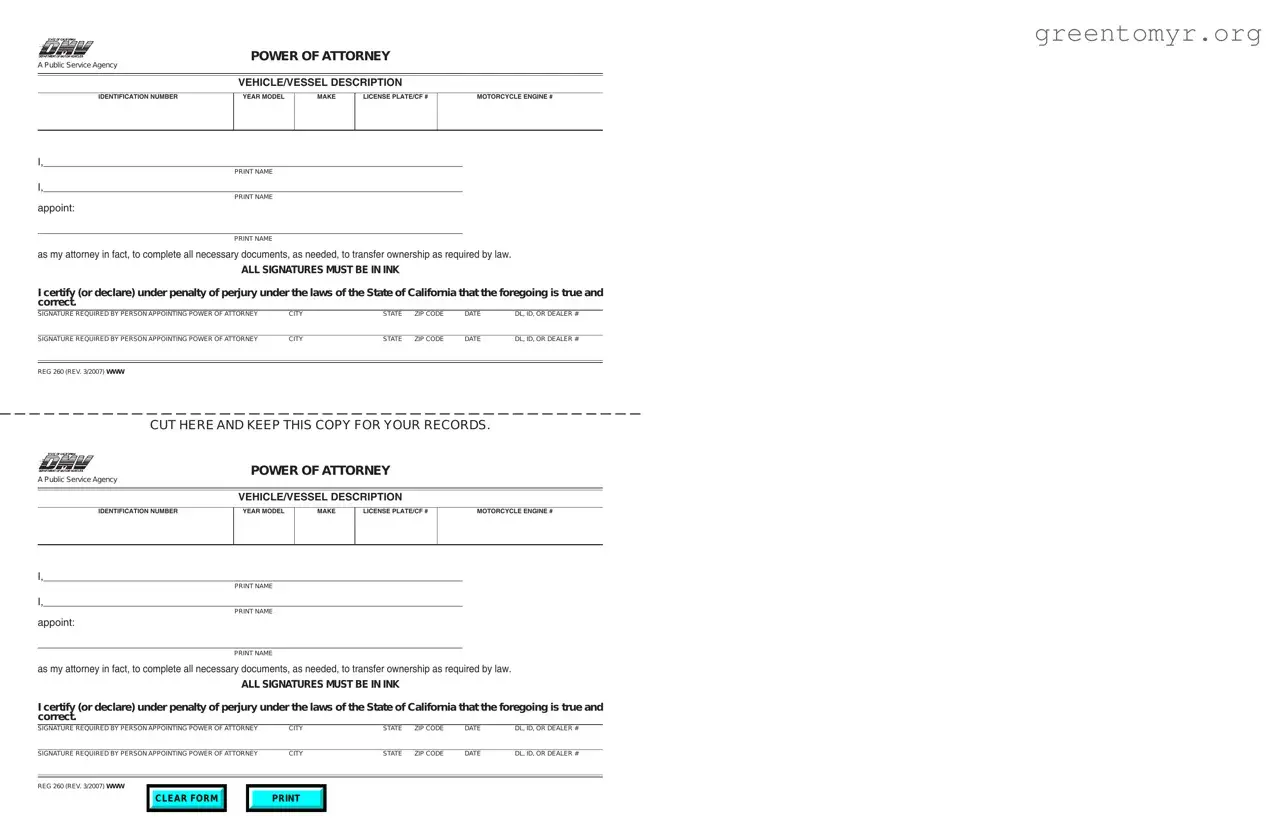
The Vehicle Power of Attorney (POA) REG 260 form is an essential document for vehicle owners in the United States who wish to authorize another person to act on their behalf in matters related to their vehicle. This form is particularly useful when the owner cannot be present for tasks such as registering the vehicle, transferring ownership, or obtaining title documents. By filling out the REG 260, the vehicle owner grants specific powers to the designated individual, known as the agent, allowing them to handle various transactions with the Department of Motor Vehicles (DMV) or other relevant authorities. The form typically requires important information, including the vehicle's details, the owner's information, and the agent's contact information. Additionally, it includes a space for the owner's signature, which is crucial for validating the authorization. Understanding the purpose and proper use of the Vehicle POA REG 260 form can help streamline vehicle-related processes and ensure that all necessary actions are carried out smoothly and legally.
POWER OF ATTORNEY
A Public Service Agency
VEHICLE/VESSEL DESCRIPTION
IDENTIFICATION NUMBER
YEAR MODEL
MAKE
LICENSE PLATE/CF #
MOTORCYCLE ENGINE #
I,________________________________________________________________________
PRINT NAME
I,________________________________________________________________________
PRINT NAME
appoint:
_________________________________________________________________________
PRINT NAME
as my attorney in fact, to complete all necessary documents, as needed, to transfer ownership as required by law.
ALL SIGNATURES MUST BE IN INK
I certify (or declare) under penalty of perjury under the laws of the State of California that the foregoing is true and correct.
SIGNATURE REQUIRED BY PERSON APPOINTING POWER OF ATTORNEY |
CITY |
STATE |
ZIP CODE |
DATE |
DL, ID, OR DEALER # |
|
|
|
|
|
|
SIGNATURE REQUIRED BY PERSON APPOINTING POWER OF ATTORNEY |
CITY |
STATE |
ZIP CODE |
DATE |
DL, ID, OR DEALER # |
|
|
|
|
|
|
|
|
|
|
|
|
REG 260 (REV. 3/2007) WWW |
|
|
|
|
|
CUT HERE AND KEEP THIS COPY FOR YOUR RECORDS.
POWER OF ATTORNEY
A Public Service Agency
VEHICLE/VESSEL DESCRIPTION
IDENTIFICATION NUMBER
YEAR MODEL
MAKE
LICENSE PLATE/CF #
MOTORCYCLE ENGINE #
I,________________________________________________________________________
PRINT NAME
I,________________________________________________________________________
PRINT NAME
appoint:
_________________________________________________________________________
PRINT NAME
as my attorney in fact, to complete all necessary documents, as needed, to transfer ownership as required by law.
ALL SIGNATURES MUST BE IN INK
I certify (or declare) under penalty of perjury under the laws of the State of California that the foregoing is true and correct.
SIGNATURE REQUIRED BY PERSON APPOINTING POWER OF ATTORNEY |
CITY |
STATE |
ZIP CODE |
DATE |
DL, ID, OR DEALER # |
|
|
|
|
|
|
SIGNATURE REQUIRED BY PERSON APPOINTING POWER OF ATTORNEY |
CITY |
STATE |
ZIP CODE |
DATE |
DL, ID, OR DEALER # |
REG 260 (REV. 3/2007) WWW
CLEAR FORM
| Fact Name | Description |
|---|---|
| Purpose | The Vehicle POA REG 260 form allows an individual to designate another person to act on their behalf in matters related to vehicle registration and title transfer. |
| Governing Law | This form is governed by the California Vehicle Code, specifically sections related to powers of attorney for vehicle transactions. |
| Who Can Use It | Any registered vehicle owner in California can use the Vehicle POA REG 260 form to grant authority to another individual. |
| Submission | The completed form must be submitted to the California Department of Motor Vehicles (DMV) to ensure the designated individual can perform the necessary actions. |
Filling out the Vehicle POA REG 260 form is a straightforward process that requires careful attention to detail. Once completed, this form will allow you to designate someone to act on your behalf regarding your vehicle. Ensure you have all necessary information at hand to expedite the process.
The Vehicle Power of Attorney (POA) REG 260 form is a document that allows an individual to authorize another person to act on their behalf regarding vehicle-related matters. This may include tasks such as transferring ownership, registering a vehicle, or obtaining a duplicate title. It is particularly useful when the vehicle owner cannot be present to complete these transactions themselves.
Any individual who is legally competent can be designated as an agent on the Vehicle POA REG 260 form. This could be a family member, friend, or professional service provider. However, it is essential to trust the person you choose, as they will have the authority to make decisions regarding your vehicle.
Notarization requirements can vary by state. In many cases, having the REG 260 form notarized is not mandatory, but it is highly recommended. Notarization adds an extra layer of authenticity and may be required by the DMV when submitting the form. Always check your state’s specific requirements to ensure compliance.
The validity of the Vehicle POA REG 260 form depends on the terms specified within the document. Typically, the authority granted remains in effect until the vehicle owner revokes it or until a specific date or condition is met. It is advisable to clearly state any expiration terms when completing the form to avoid confusion.
Yes, you can revoke the Vehicle POA REG 260 form at any time. To do so, you should create a written notice of revocation and provide it to the designated agent. It is also a good idea to inform the DMV or relevant authority to ensure that your records are updated accordingly. Keep a copy of the revocation notice for your records.
If your designated agent is unable to fulfill their duties for any reason, you have a couple of options. First, you can revoke the existing POA and designate a new agent. Alternatively, if the situation is temporary, you might allow the agent to delegate their responsibilities to another trusted individual, provided that you grant your consent.
The completed Vehicle POA REG 260 form should typically be submitted to your state’s Department of Motor Vehicles (DMV) or equivalent agency. Some states may allow you to submit the form online, while others may require you to deliver it in person or by mail. Always check your state’s guidelines for the most accurate submission process.
When completing the Vehicle Power of Attorney (POA) REG 260 form, individuals often encounter common pitfalls that can lead to delays or complications. One frequent mistake is not providing accurate information regarding the vehicle. This includes errors in the Vehicle Identification Number (VIN) or the make and model of the car. Such inaccuracies can cause issues when attempting to transfer ownership or handle other transactions related to the vehicle.
Another common error is failing to sign the form correctly. The Vehicle POA REG 260 requires signatures from both the principal and the agent. If either party neglects to sign or uses a signature that does not match their legal name, the form may be deemed invalid. It is essential to ensure that all signatures are clear and legible to avoid complications.
Many individuals also overlook the importance of including the date on which the form is completed. Without a date, the form may not be considered valid, and it could lead to disputes regarding the timing of the authority granted. Properly dating the form provides clarity and helps establish a timeline for any actions taken under the power of attorney.
Additionally, people often forget to provide a clear description of the powers granted to the agent. The Vehicle POA REG 260 form allows for specific instructions, and failing to articulate these can lead to misunderstandings. It is crucial to be explicit about what actions the agent is authorized to take on behalf of the principal.
Lastly, not keeping a copy of the completed form is a mistake that can have significant consequences. After submitting the Vehicle POA REG 260, individuals should retain a copy for their records. This ensures that both the principal and the agent have access to the document if questions arise in the future. Keeping a copy can help prevent disputes and provide clarity regarding the authority granted.
The Vehicle Power of Attorney (POA) REG 260 form is an important document for vehicle transactions. It allows one person to act on behalf of another in matters related to vehicle ownership. However, several other forms and documents often accompany this form to ensure a smooth process. Below is a list of these documents, each serving a specific purpose.
Having these documents ready can streamline the process of transferring vehicle ownership and ensure compliance with state regulations. Each form plays a crucial role in protecting the interests of all parties involved.
The Vehicle Power of Attorney (POA) REG 260 form serves a specific purpose in the realm of vehicle ownership and transfer. However, it shares similarities with several other documents that also facilitate the delegation of authority or the transfer of rights. Here’s a look at ten documents that are comparable to the Vehicle POA REG 260 form:
Each of these documents plays a crucial role in delegating authority or transferring rights, reflecting the importance of clear and effective communication in legal matters.
When filling out the Vehicle POA REG 260 form, it is important to follow certain guidelines to ensure the process goes smoothly. Below are six key do's and don'ts to keep in mind.
The Vehicle Power of Attorney (POA) REG 260 form is often misunderstood. Here are six common misconceptions about this important document:
Understanding these misconceptions can help individuals make informed decisions when using the Vehicle POA REG 260 form.
When filling out and using the Vehicle Power of Attorney (POA) REG 260 form, it is essential to understand several key points to ensure a smooth process. Below are some important takeaways:
By keeping these points in mind, you can effectively navigate the process of using the Vehicle POA REG 260 form.