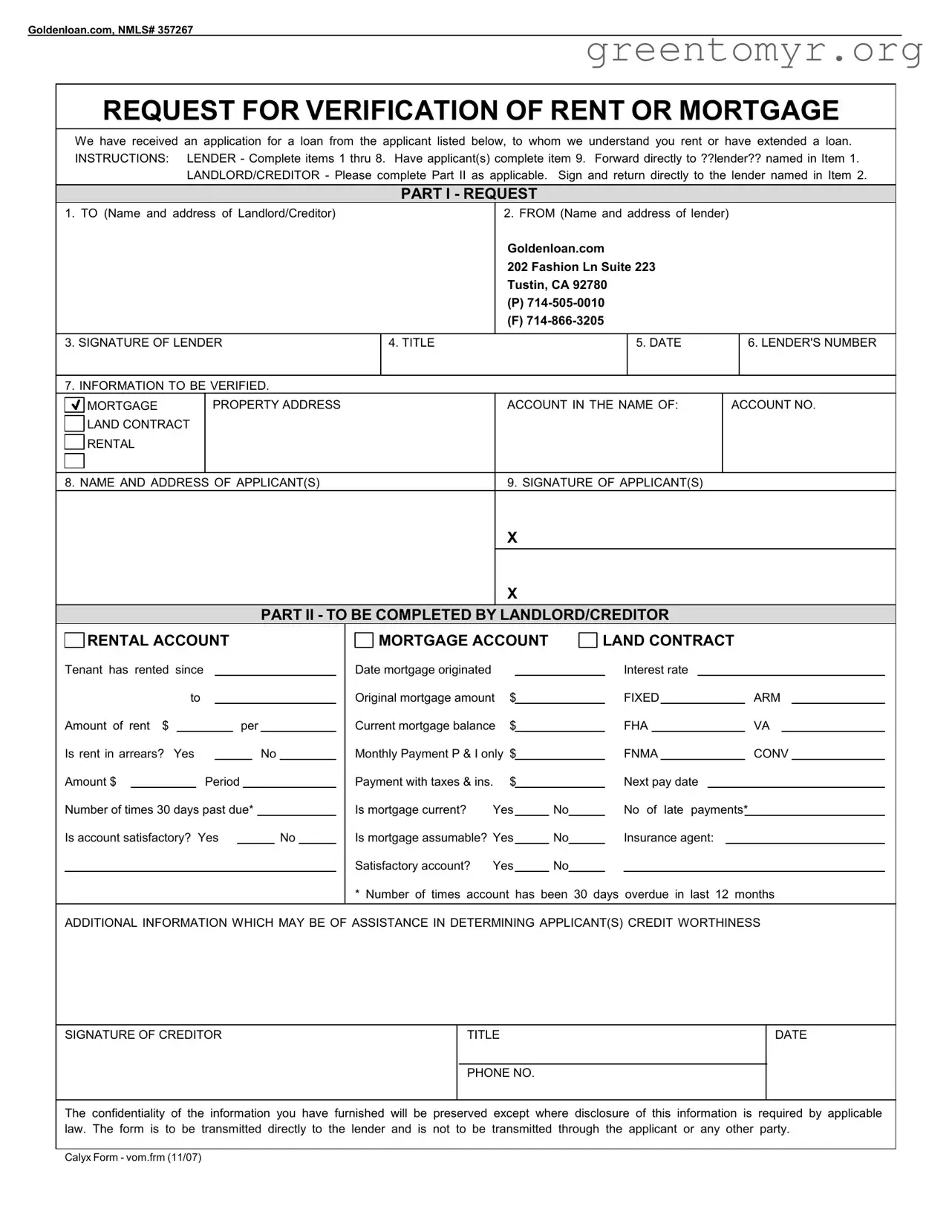
The Verification Rent Mortgage form plays a crucial role in the loan application process by providing essential information regarding an applicant's rental or mortgage history. This form is typically initiated by a lender who requests verification from a landlord or creditor about the applicant's financial responsibilities. It includes specific sections that need to be filled out by both the lender and the landlord or creditor, ensuring that all pertinent details are accurately documented. Key components of the form encompass the identification of the lender and the landlord, the applicant's information, and various fields to verify the rental or mortgage account status. The form also inquires about the payment history, including any arrears, the current balance, and whether the account is considered satisfactory. Furthermore, it emphasizes the importance of confidentiality, stating that the information provided will remain protected unless disclosure is mandated by law. This structured approach not only facilitates the verification process but also aids in assessing the creditworthiness of the applicant.
GOLDENLOAN.COM, NMLS# 357267
REQUEST FOR VERIFICATION OF RENT OR MORTGAGE
We have received an application for a loan from the applicant listed below, to whom we understand you rent or have extended a loan. INSTRUCTIONS: LENDER - Complete items 1 thru 8. Have applicant(s) complete item 9. Forward directly to ??lender?? named in Item 1.
LANDLORD/CREDITOR - Please complete Part II as applicable. Sign and return directly to the lender named in Item 2.
PART I - REQUEST
1. TO (Name and address of Landlord/Creditor)
2. FROM (Name and address of lender)
GOLDENLOAN.COM
202 FASHION LN SUITE 223 TUSTIN, CA 92780
(P)
(F)
3. SIGNATURE OF LENDER
4. TITLE
5. DATE
6. LENDER'S NUMBER
7. INFORMATION TO BE VERIFIED.
MORTGAGE |
PROPERTY ADDRESS |
ACCOUNT IN THE NAME OF: |
ACCOUNT NO. |
LAND CONTRACT |
|
|
|
RENTAL |
|
|
|
|
|
|
|
8. NAME AND ADDRESS OF APPLICANT(S) |
9. SIGNATURE OF APPLICANT(S) |
|
|
X
X
PART II - TO BE COMPLETED BY LANDLORD/CREDITOR
RENTAL ACCOUNT
Tenant has rented since |
|
|
|
|
|
||||||||
|
|
to |
|
|
|
|
|||||||
Amount of rent $ |
|
|
|
|
per |
|
|
|
|
||||
Is rent in arrears? Yes |
|
|
|
|
|
|
|
No |
|
||||
Amount $ |
|
Period |
|
|
|
|
|
||||||
Number of times 30 days past due* |
|
|
|
|
|
||||||||
Is account satisfactory? |
Yes |
|
|
|
No |
|
|||||||
MORTGAGE ACCOUNT
Date mortgage originated |
|
|
|
|
Original mortgage amount |
$ |
|
||
Current mortgage balance |
$ |
|
||
Monthly Payment P & I only $ |
|
|||
Payment with taxes & ins. |
$ |
|
||
Is mortgage current? |
Yes |
|
No |
|
Is mortgage assumable? Yes |
|
No |
||
Satisfactory account? |
Yes |
|
No |
|
LAND CONTRACT
Interest rate
FIXEDARM
FHAVA
FNMACONV
Next pay date
No of late payments*
Insurance agent:
* Number of times account has been 30 days overdue in last 12 months
ADDITIONAL INFORMATION WHICH MAY BE OF ASSISTANCE IN DETERMINING APPLICANT(S) CREDIT WORTHINESS
SIGNATURE OF CREDITOR
TITLE
PHONE NO.
DATE
The confidentiality of the information you have furnished will be preserved except where disclosure of this information is required by applicable law. The form is to be transmitted directly to the lender and is not to be transmitted through the applicant or any other party.
Calyx Form - vom.frm (11/07)
| Fact Name | Description |
|---|---|
| Purpose | The Verification Rent Mortgage form is used to confirm an applicant's rental or mortgage payment history for loan applications. |
| Parties Involved | The form involves three main parties: the lender, the landlord or creditor, and the applicant. |
| Instructions for Lender | The lender must complete items 1 through 8 and ensure the applicant fills out item 9 before sending it to the designated lender. |
| Landlord/Creditor Responsibilities | Landlords or creditors must fill out Part II and return the form directly to the lender without involving the applicant. |
| Confidentiality Clause | The form states that the information provided will be kept confidential unless required by law to disclose it. |
| Governing Laws | For California, relevant laws include the California Civil Code Section 1785.1 regarding consumer credit reporting. |
Completing the Verification Rent Mortgage form is an essential step in the loan application process. Follow these steps carefully to ensure accurate and timely submission.
Once the lender completes their sections, the landlord or creditor must fill out Part II. This includes providing details about the rental or mortgage account, confirming payment status, and adding any additional information that may assist in evaluating the applicant's creditworthiness. After completing Part II, the landlord or creditor should sign and return the form directly to the lender.
The Verification Rent Mortgage form is a document used to verify an applicant's rental or mortgage payment history. It is typically completed by landlords or creditors to provide lenders with the necessary information regarding an applicant’s financial obligations. This form is crucial in the loan approval process as it helps assess the applicant's creditworthiness.
Two parties are involved in completing the Verification Rent Mortgage form:
Once completed, the form must be sent directly to the lender listed in the document. It should not be transmitted through the applicant or any other intermediary. This ensures that the information remains confidential and is received by the appropriate party.
The lender must complete items 1 through 8 on the form. This includes:
In Part II, the landlord or creditor must provide information such as:
If the rent or mortgage is in arrears, the landlord or creditor must indicate this on the form. They should specify the amount overdue and how many times the account has been 30 days past due within the last 12 months. This information is critical for the lender to assess the risk associated with the applicant.
Yes, the information provided on the Verification Rent Mortgage form is confidential. It will be preserved unless disclosure is required by law. This confidentiality helps protect the privacy of the applicant and ensures that sensitive financial information is handled appropriately.
If you have questions about completing the Verification Rent Mortgage form, it is advisable to reach out directly to the lender or consult with a legal or financial advisor. They can provide guidance on how to accurately fill out the form and ensure that all necessary information is included.
Completing the Verification Rent Mortgage form accurately is crucial for a smooth loan application process. However, many applicants make common mistakes that can lead to delays or even denials. Here are ten frequent errors to avoid.
First, applicants often forget to fill out their personal information completely. Missing details such as the full name, current address, or contact number can cause confusion and delay the verification process. Ensure all information is accurate and up-to-date.
Second, the section where the landlord or creditor's information is provided is sometimes incomplete. This includes the name and address of the landlord or creditor. If this information is not correctly filled out, the lender may struggle to reach the right person for verification.
Third, applicants frequently neglect to sign the form. A signature is required to validate the request. Without it, the form may be considered invalid, halting the entire process.
Fourth, some individuals do not verify the accuracy of the rental or mortgage account details. Incorrect account numbers or addresses can lead to significant delays as lenders attempt to rectify the errors.
Fifth, applicants often overlook the importance of providing information about any late payments. If there have been late payments, it is essential to disclose this information. Failing to do so can create distrust and potentially jeopardize the loan application.
Sixth, many people fail to indicate whether the rent is in arrears. This section is crucial for the lender to assess the applicant's financial stability. Transparency in this area can enhance credibility.
Seventh, applicants sometimes forget to include additional information that could support their creditworthiness. Providing context or explanations for any financial difficulties can be beneficial.
Eighth, the date of the mortgage origination is often left blank. This date is vital for lenders to understand the history of the mortgage and its current status. Ensure this detail is filled in accurately.
Ninth, applicants might not check the box indicating whether the mortgage is current. This simple oversight can lead to misunderstandings regarding the applicant's financial obligations.
Lastly, many individuals do not follow the instruction to send the form directly to the lender. Instead, they may attempt to submit it through other parties. This can lead to confidentiality issues and further delays in processing.
By avoiding these common mistakes, applicants can ensure a smoother verification process and increase their chances of securing a loan. Attention to detail is essential when filling out the Verification Rent Mortgage form.
When applying for a loan, several documents work together to paint a complete picture of your financial situation. Alongside the Verification Rent Mortgage form, you may encounter the following important forms and documents. Each serves a unique purpose in the lending process.
Gathering these documents can feel overwhelming, but each one plays a vital role in the loan approval process. Being prepared with the necessary paperwork can make your experience smoother and increase your chances of securing the financing you need.
The Verification Rent Mortgage form serves an important role in the loan application process, providing essential information about an applicant's rental or mortgage history. There are several other documents that share similarities with this form, each designed to verify financial responsibilities and obligations. Below are four such documents:
When filling out the Verification Rent Mortgage form, attention to detail is essential. Here’s a list of things to do and avoid to ensure a smooth process.
By following these guidelines, you can help ensure that the verification process goes smoothly and efficiently.
Understanding the Verification Rent Mortgage form is crucial for both lenders and borrowers. Unfortunately, several misconceptions surround this important document. Here are five common misunderstandings:
Clearing up these misconceptions can help streamline the loan application process and ensure that all parties understand their responsibilities. Proper use of the Verification Rent Mortgage form is essential for a smooth transaction.
When filling out and using the Verification Rent Mortgage form, consider the following key takeaways:
Following these guidelines will facilitate a smooth verification process and help ensure that all necessary information is accurately conveyed.