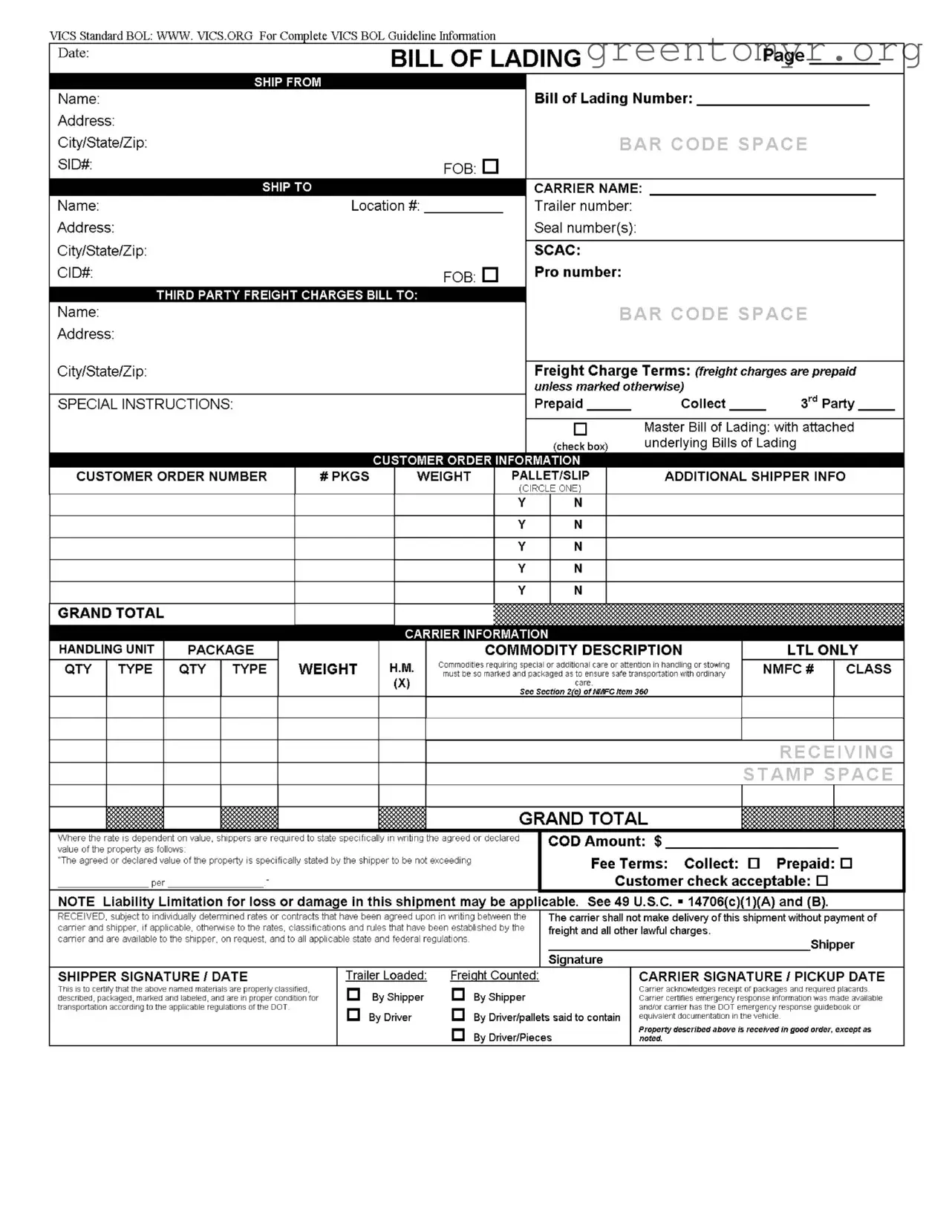
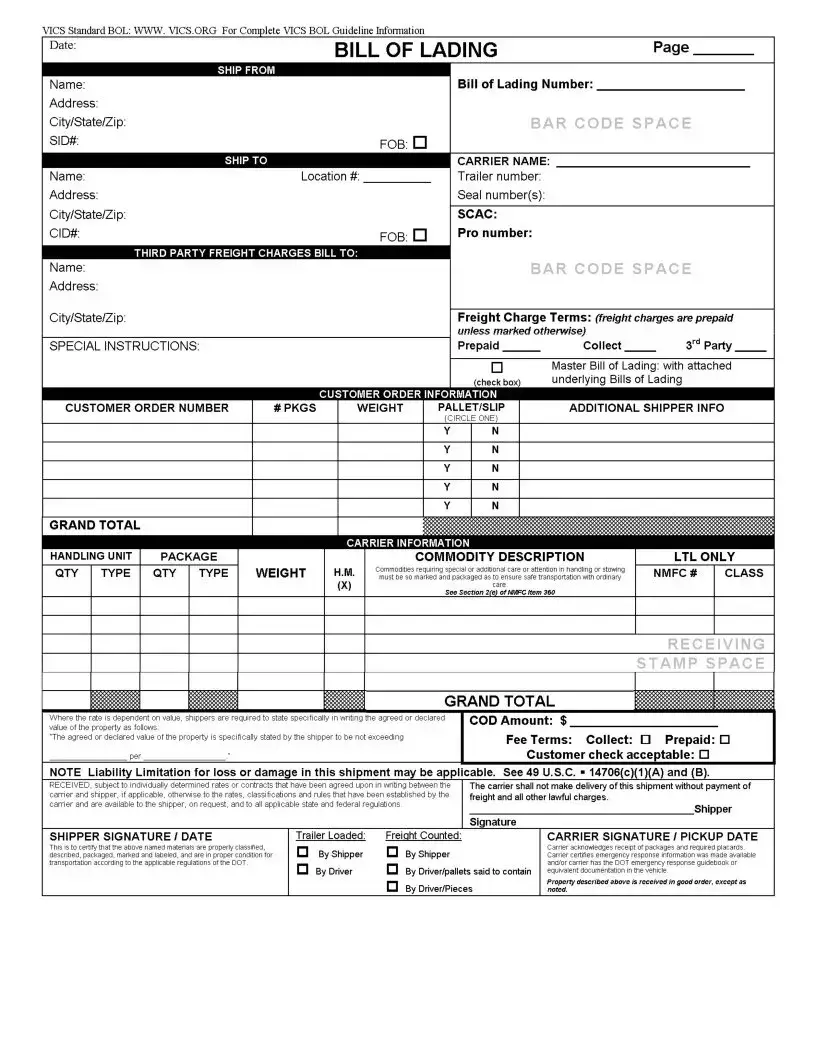
The VICS Bill of Lading (BOL) form is a crucial document in the shipping and logistics industry, serving as a receipt for goods and a contract between the shipper and the carrier. This form captures essential information, including the shipper's and carrier's details, freight charge terms, and special instructions that may apply to the shipment. It outlines the customer order number, package quantities, and weight, ensuring that all parties have a clear understanding of what is being transported. Furthermore, the VICS BOL emphasizes the importance of proper packaging and labeling, especially for commodities requiring special handling. It also includes sections for the declaration of value, which is vital for determining liability in case of loss or damage during transit. The form requires signatures from both the shipper and the carrier, confirming that the goods are in suitable condition for transportation and that all regulations are met. By adhering to the guidelines set forth in the VICS BOL, shippers and carriers can facilitate smoother transactions and minimize disputes, ultimately enhancing the efficiency of the shipping process.
VICS Standard BQL: WWW. VICS.QRG For Complete VICS BQL Guideline Information
I Date: |
|
BILL OF LADING |
|
Page |
|
|
|
|
|||
Name: |
|
|
Bill of Lading Number: |
|
|
Address: |
|
|
|
|
|
City/State/Zip: |
|
|
BAR CODE SPACE |
||
SID#: |
|
FOB: |
|
|
|
|
|
|
CARRIER NAME: |
|
|
|
|
|
Trailer number: |
|
|
|
|
|
Seal number(s): |
|
|
|
|
|
SCAC: |
|
|
|
|
|
Pro number: |
|
|
|
|
|
BAR CODE SPACE |
||
|
|
|
Freight Charge Terms: (freight charges are prepaid |
||
|
|
|
unless marked otherwise) |
3rd Party |
|
SPECIAL INSTRUCTIONS: |
|
|
Prepaid |
Collect |
|
|
|
|
|
Master Bill of Lading: with attached |
|
|
|
|
(check box) |
underlying Bills of Lading |
|
CUSTOMER ORDER NUMBER |
# PKGS |
WEIGHT |
PALLET/SLIP |
ADDITIONAL SHIPPER INFO |
|
|
|
|
(CIRCLE ONE) |
|
|
GRAND TOTAL
HANDLING UNIT |
PACKAGE |
WEIGHT |
COMMODITY DESCRIPTION |
LTL ONLY |
|
QTY TYPE |
QTY TYPE |
Commodities requiring special or additional care or attention in handling or stowing |
NMFC# |
CLASS |
|
must be so marked and packaged as to ensure safe transportation with ordinary |
|||||
care.
See Section 2(e) ofNMFC Item 360
RECEIVING
STAMP SPACE
GRAND TOTAL
Where the rate is dependent on value, shippers are required to state specifically in writing the agreed or declared value of the property as follows:
COD Amount: $
"The agreed or declared value of the property is specifically stated by the shipper to be not exceeding |
Fee Terms: Collect: |
Prepaid: |
|
||
per |
Customer check acceptable: |
|
NOTE Liability Limitation for loss or damage in this shipment may be applicable. See 49 U.S.C. ■ 14706(c)(1)(A) and (B).
RECEIVED, subject to individually determined rates or contracts that have been agreed upon in writing between the |
The carrier shall not make delivery of this shipment without payment of |
carrier and shipper, if applicable, otherwise to the rates, classifications and rules that have been established by the |
freight and all other lawful charges. |
carrier and are available to the shipper, on request, and to all applicable state and federal regulations. |
Shipper |
|
|
|
Signature |
SHIPPER SIGNATURE / DATE |
Trailer Loaded: |
Freight Counted: |
|
This is to certify that the above named materials are properly classified, |
О |
By Shipper |
О By Shipper |
described, packaged, marked and labeled, and are in proper condition for |
|||
transportation according to the applicable regulations of the DOT. |
Q |
By Driver |
О By Driver/pallets said to contain |
|
|||
CARRIER SIGNATURE / PICKUP DATE
Carrier acknowledges receipt of packages and required placards. Carrier certifies emergency response information was made available and/or carrier has the DOT emergency response guidebook or equivalent documentation in the vehicle.
О By Driver/Pieces |
Property described above is received in good order, except as |
|
noted. |
||
|
VICS Standard BQL: WWW.VICS.ORG For Complete VICS BQL Guideline Information__________________________________________________________________
Date |
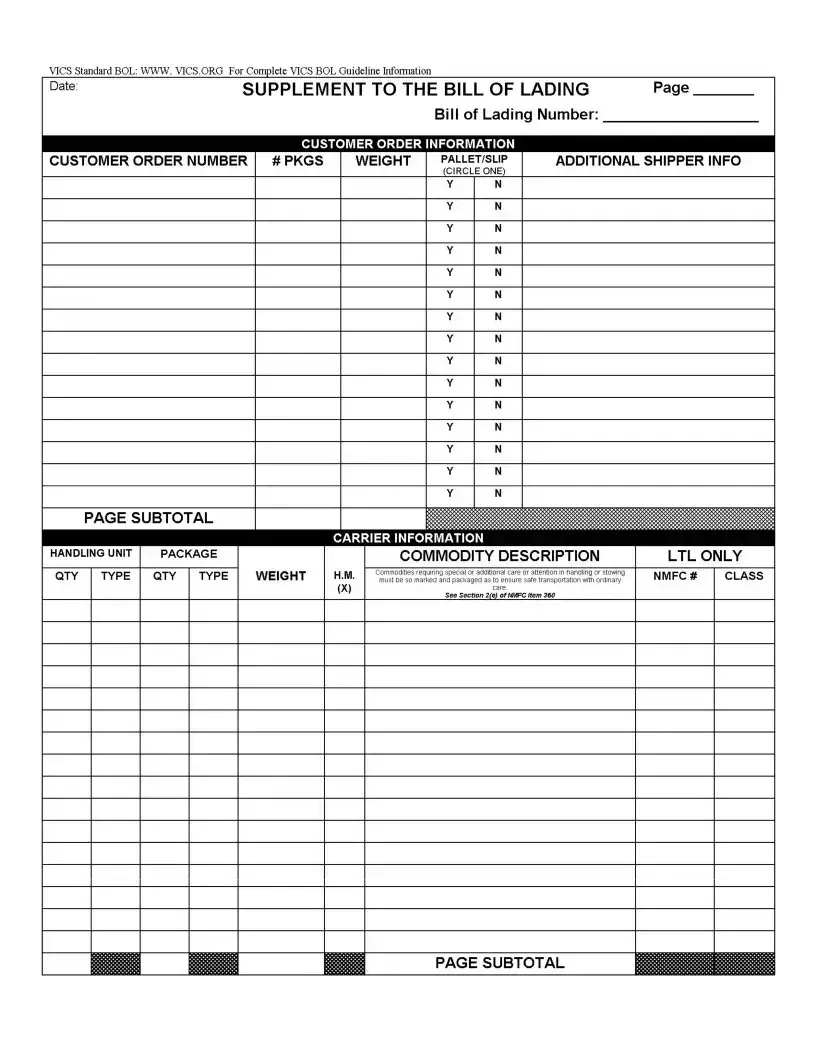
SUPPLEMENT TO THE BILL OF LADING |
Page |
|
Bill of Lading Number: |
|
| Fact Name | Details |
|---|---|
| Purpose | The VICS Bill of Lading (BOL) serves as a receipt for goods and a contract between the shipper and carrier. |
| Governing Law | In the United States, the VICS BOL is governed by the Uniform Commercial Code (UCC) and federal regulations, including 49 U.S.C. § 14706. |
| Prepaid Charges | Freight charges are typically prepaid unless otherwise indicated on the form. |
| Special Instructions | Shippers can include specific instructions regarding the shipment, which must be clearly noted. |
| Liability Limitations | Liability for loss or damage may be limited, as outlined in 49 U.S.C. § 14706(c)(1)(A) and (B). |
| Emergency Response | The carrier must have access to emergency response information or the DOT emergency response guidebook. |
| Signature Requirements | Both the shipper and carrier must sign the BOL to confirm receipt of the goods and their condition. |
| Commodity Description | Shippers must accurately describe the commodities being shipped, including weight and type. |
| State-Specific Variations | Some states may have additional regulations affecting the use of the VICS BOL; it's important to consult local laws. |
Filling out the VICS Bill of Lading (BOL) form is a straightforward process. This form is essential for shipping and ensures that all necessary information is documented correctly. Below are the steps to guide you through completing the form.
Once you have completed all the sections, review the form for accuracy before submitting it. Ensuring that every detail is correct will help avoid any issues during the shipping process.
The VICS Bill of Lading (BOL) form is a standard document used in shipping and logistics. It outlines the details of the shipment, including the sender, recipient, and the goods being transported. This form helps ensure that all parties involved have a clear understanding of the shipment's specifics.
You will need to provide several key details on the form, including:
The freight charge terms indicate how the shipping costs will be handled. You can select from:
If your shipment requires special care, you must clearly mark it on the form. Ensure that the goods are packaged appropriately to prevent damage during transit. This will help ensure safe transportation.
The customer order information section allows you to provide details about the order being shipped. This includes the customer order number, the number of packages, and the total weight. This information helps keep track of the shipment and ensures accuracy.
The liability limitation note indicates that there may be restrictions on the carrier's liability for loss or damage during shipment. It's essential to understand these limitations, as they can affect any claims you might need to make in case of an issue.
To certify the shipment's condition, you must sign and date the form. This signature confirms that the materials are properly classified, packaged, and in good condition for transportation. Make sure to review everything before signing.
The carrier's signature on the VICS BOL form acknowledges receipt of the packages and certifies that the shipment is in good order. This signature is important for both the shipper and the carrier, as it serves as proof of delivery.
For complete VICS BOL guideline information, you can visit the official VICS website at www.vics.org. This site provides detailed resources and updates related to the Bill of Lading and other shipping standards.
If you have additional questions, consider reaching out to your shipping carrier or logistics provider. They can offer guidance specific to your situation and ensure that your form is completed correctly.
Filling out the VICS Bill of Lading (BOL) form correctly is crucial for ensuring smooth transportation of goods. However, many people make common mistakes that can lead to delays or complications. Here are five frequent errors to watch out for.
One of the most common mistakes is leaving out essential information. The VICS BOL requires specific details such as the shipper's name, address, and contact information. Failing to include these can result in confusion and delays in processing the shipment. Always double-check that all fields are filled out completely.
Another frequent error involves mislabeling the freight charges. The form provides options for prepaid, collect, or third-party billing, and selecting the wrong option can lead to billing disputes later on. Make sure to carefully review the payment terms and mark the appropriate box to avoid misunderstandings.
Many individuals also overlook the importance of accurately describing the commodities being shipped. The section for package commodity description should include the correct quantity and type of items. Inaccurate descriptions can lead to issues with customs or delivery, so it’s vital to provide precise information.
Additionally, some people forget to include special instructions when necessary. If the shipment contains items that require special handling, this information should be clearly noted in the special instructions section. This ensures that the carrier is aware of any special care needed during transportation.
Lastly, neglecting to sign and date the form can render it invalid. The shipper's signature is a critical part of the BOL, confirming that all information provided is accurate and that the goods are ready for transport. Always ensure that the form is signed and dated before submission.
The VICS Bill of Lading (BOL) form is a crucial document in the shipping and logistics industry. It serves as a receipt for goods, a contract between the shipper and carrier, and a document of title. When using the VICS BOL form, several other documents may also be required to ensure smooth operations. Below is a list of commonly used forms and documents that accompany the VICS BOL.
Understanding these documents can help streamline the shipping process and ensure compliance with regulations. Each document plays a specific role in facilitating the safe and efficient transport of goods, making them essential for anyone involved in logistics and shipping.
When filling out the VICS BOL form, it’s important to follow certain guidelines to ensure accuracy and compliance. Here’s a list of things you should and shouldn’t do:
Following these tips will help ensure that your VICS BOL form is filled out correctly and efficiently.
Misconceptions about the VICS BOL form can lead to confusion and errors in shipping. Here are seven common misunderstandings:
Understanding these misconceptions can help ensure a smoother shipping process. Always refer to the complete VICS BOL guidelines for detailed instructions.
When it comes to filling out and using the VICS Bill of Lading (BOL) form, understanding the key components can make the process smoother and more efficient. Here are some essential takeaways to keep in mind:
By following these guidelines, you can ensure that your use of the VICS Bill of Lading form is effective and compliant with necessary regulations. Remember, attention to detail can save you time and trouble down the road.