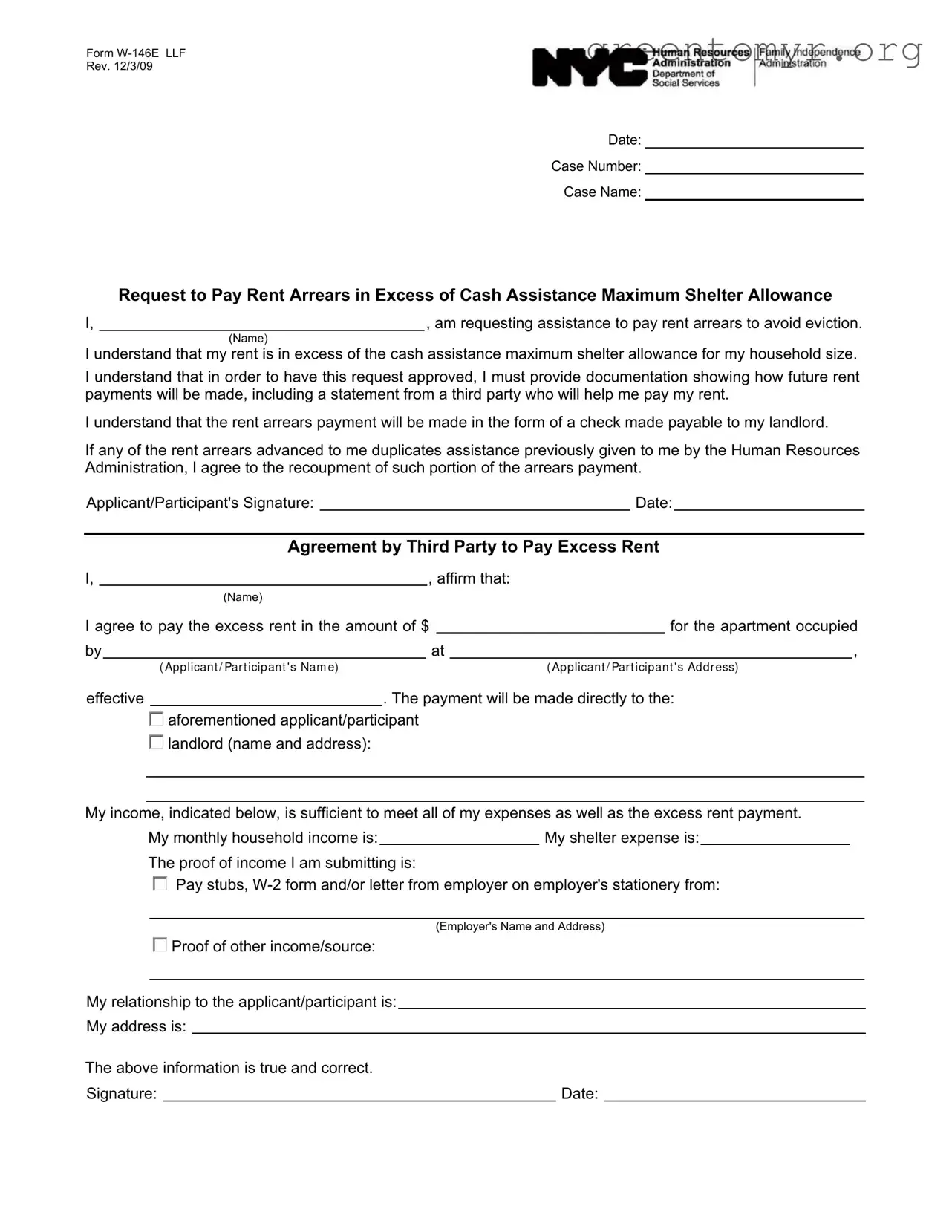
The W-146E form serves as a crucial tool for individuals facing financial difficulties, specifically those struggling with rent arrears that exceed the cash assistance maximum shelter allowance. This form is designed to facilitate requests for assistance to prevent eviction by providing a structured process for applicants to document their circumstances. When filling out the W-146E, applicants must clearly state their name, case number, and the amount of rent arrears they are seeking assistance for. Additionally, it is essential for applicants to include documentation that outlines how they plan to manage future rent payments. This often involves a statement from a third party who commits to aiding in the payment of rent. The completed form not only requires the applicant's signature but also includes a section for a third party to affirm their agreement to cover the excess rent. They must provide their own financial information to demonstrate the ability to meet this obligation. Understanding the requirements and implications of the W-146E form is vital for those seeking assistance, as it can significantly impact their housing stability.
Form
Rev. 12/3/09
Date:
Case Number:
Case Name:
|
Request to Pay Rent Arrears in Excess of Cash Assistance Maximum Shelter Allowance |
|
I, |
|
, am requesting assistance to pay rent arrears to avoid eviction. |
|
(Name) |
|
I understand that my rent is in excess of the cash assistance maximum shelter allowance for my household size.
I understand that in order to have this request approved, I must provide documentation showing how future rent payments will be made, including a statement from a third party who will help me pay my rent.
I understand that the rent arrears payment will be made in the form of a check made payable to my landlord.
If any of the rent arrears advanced to me duplicates assistance previously given to me by the Human Resources Administration, I agree to the recoupment of such portion of the arrears payment.
Applicant/Participant's Signature:Date:
Agreement by Third Party to Pay Excess Rent
I, |
|
, affirm that: |
|
|
|
|||||
|
|
|
(Name) |
|
|
|
|
|
|
|
I agree to pay the excess rent in the amount of $ |
|
|
for the apartment occupied |
|||||||
by |
|
|
at |
|
|
, |
||||
|
|
|
( App lican t / Par t icip an t ' s Nam e) |
|
|
|
|
( Ap plican t / Par t icipan t ' s Ad dr ess) |
||
effective |
|
. The payment will be made directly to the: |
||||||||
cef aforementioned applicant/participant cef landlord (name and address):
My income, indicated below, is sufficient to meet all of my expenses as well as the excess rent payment.
My monthly household income is:My shelter expense is: The proof of income I am submitting is:
cef Pay stubs,
(Employer's Name and Address)
cef Proof of other income/source:
My relationship to the applicant/participant is:
My address is:
The above information is true and correct.
Signature:Date:
| Fact Name | Description |
|---|---|
| Form Title | The form is titled "W-146E LLF" and is used for requesting assistance with rent arrears. |
| Purpose | This form helps individuals request financial aid to cover rent arrears that exceed the cash assistance maximum shelter allowance. |
| Documentation Required | Applicants must provide proof of how future rent payments will be made, including a statement from a third party who will assist with payments. |
| Payment Method | Any approved rent arrears payment will be issued as a check made out to the landlord. |
| Recoupment Agreement | If the assistance duplicates previous aid from the Human Resources Administration, the applicant agrees to repay that portion. |
| Governing Law | This form is governed by New York State laws regarding public assistance and housing support. |
Filling out the W-146E form is a crucial step for individuals seeking assistance with rent arrears. This form requires careful attention to detail to ensure that all necessary information is accurately provided. Following the steps below will help in completing the form correctly.
Once you have filled out the form, ensure that all required documentation is attached before submitting it to the appropriate agency. This will facilitate the review process and help avoid any delays in assistance.
Form W-146E is a request form used by individuals seeking assistance to pay rent arrears that exceed the maximum shelter allowance provided by cash assistance programs. It is specifically designed to help those at risk of eviction due to unpaid rent. By completing this form, applicants can outline their situation and seek financial help to avoid losing their homes.
This form is intended for individuals who are currently receiving cash assistance but find themselves in a situation where their rent is higher than the maximum shelter allowance. If you are facing eviction due to rent arrears and need financial assistance to pay your landlord, this form is for you.
When filling out Form W-146E, you will need to provide:
To support your request, you must provide documentation that demonstrates your ability to make future rent payments. This includes:
Additionally, a third party who agrees to assist with the rent must also provide their income information and relationship to you.
If your request for assistance is approved, the payment will be issued in the form of a check made payable directly to your landlord. This ensures that the funds are used specifically for addressing the rent arrears you have outlined in your request.
If you have previously received assistance for the same rent arrears, any duplicated payment will be recouped. This means that the amount you received that overlaps with your current request will be deducted from the new assistance provided.
Once you have completed Form W-146E and gathered all necessary documentation, you should submit it to your local Human Resources Administration (HRA) office. It is advisable to keep a copy of the completed form and all documents for your records before submission.
Filling out Form W-146E can be a straightforward process, but several common mistakes can lead to delays or denials of assistance. One frequent error is leaving the case number blank. This number is essential for identifying the application and ensuring it is processed correctly. Always double-check that this field is filled in accurately.
Another mistake is failing to provide a complete name in the applicant's section. The form requires the full legal name of the individual requesting assistance. Omitting or misspelling this information can complicate the processing of the request.
In addition, applicants often forget to include the date of their request. This detail is crucial for tracking the timeline of assistance and can affect the urgency of the case. It is important to ensure that the date is current and correctly entered.
Providing insufficient documentation is another common pitfall. The form requires proof of how future rent payments will be made, including a statement from a third party. Many applicants overlook this requirement, which can result in a denial. Be sure to attach all necessary documents to support the request.
Misunderstanding the relationship to the applicant can also lead to errors. When filling out the section regarding the third party's relationship to the applicant, applicants sometimes provide vague or incorrect information. Clear and accurate descriptions are essential for establishing credibility.
Another mistake involves the income declaration. Applicants may inaccurately report their monthly household income or shelter expenses. It is crucial to provide precise figures to avoid complications later. Double-checking these amounts can prevent issues during the review process.
Some individuals may also neglect to include their signature and the date on the application. This omission can render the form invalid. Always ensure that both the applicant and any third party involved sign and date the form before submission.
Lastly, failing to provide a clear and correct address can lead to communication issues. The form requires the applicant's and third party's addresses to ensure that all correspondence reaches the appropriate individuals. It is advisable to verify that these addresses are accurate and up-to-date.
When submitting the W-146E form, several other documents may be required to support your request for assistance. These documents help provide a complete picture of your situation and ensure that your application is processed smoothly. Below is a list of commonly used forms and documents that accompany the W-146E.
Gathering these documents promptly can significantly impact the speed and success of your request. Ensure that all information is accurate and up-to-date to avoid delays in processing your application.
The W-146E form is a request for assistance to pay rent arrears that exceed the cash assistance maximum shelter allowance. Several other documents serve similar purposes in different contexts. Here are four documents that share similarities with the W-146E form:
When filling out the W-146E form, it's important to follow certain guidelines to ensure your application is processed smoothly. Here are some dos and don'ts to keep in mind:
Understanding the W 146E form is essential for those seeking assistance with rent arrears. However, several misconceptions can lead to confusion. Here are seven common misunderstandings:
Addressing these misconceptions can help individuals navigate the process more effectively and secure the assistance they need.
When filling out the W-146E form, there are several important points to keep in mind to ensure a smooth process. Here are some key takeaways:
By keeping these takeaways in mind, you can navigate the process of filling out and using the W-146E form with greater confidence and clarity.