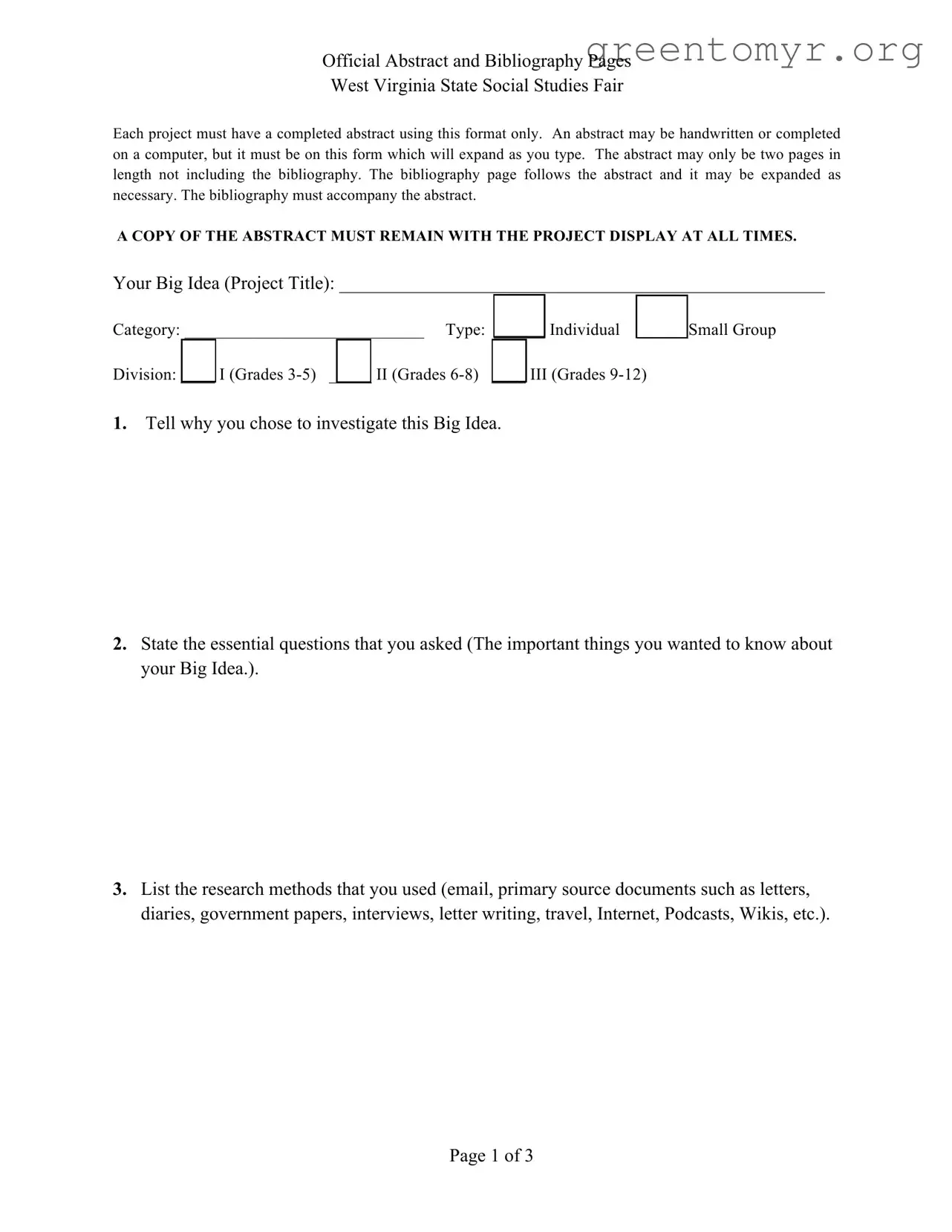
The West Virginia Abstract Social Studies Fair form serves as a crucial component for students participating in the state's social studies fair. This form guides participants in presenting their research in a structured manner, ensuring that key elements are included. Each project requires an abstract that must adhere to specific formatting guidelines, allowing for either handwritten or computer-generated submissions. The abstract is limited to two pages, excluding the bibliography, which follows and can be expanded as necessary. Participants must provide essential information, including the project title, category, and division, along with a rationale for their chosen topic. They are also asked to articulate the essential questions that guided their inquiry and to detail the research methods utilized. Furthermore, the form prompts students to validate their sources, summarize their findings, and draw conclusions. An important aspect of the submission is that a copy of the abstract must remain with the project display at all times. Completing the bibliography is also essential, requiring a specific format that includes necessary publication details. This form not only facilitates the organization of research but also enhances the educational experience for young scholars in West Virginia.

Official Abstract and Bibliography Pages
West Virginia State Social Studies Fair
Each project must have a completed abstract using this format only. An abstract may be handwritten or completed on a computer, but it must be on this form which will expand as you type. The abstract may only be two pages in length not including the bibliography. The bibliography page follows the abstract and it may be expanded as necessary. The bibliography must accompany the abstract.
A COPY OF THE ABSTRACT MUST REMAIN WITH THE PROJECT DISPLAY AT ALL TIMES.
Your Big Idea (Project Title): ____________________________________________________
Category: ____________________________ Type: ______ Individual ______Small Group
Division: ____ I (Grades
1.Tell why you chose to investigate this Big Idea.
2.State the essential questions that you asked (The important things you wanted to know about your Big Idea.).
3.List the research methods that you used (email, primary source documents such as letters, diaries, government papers, interviews, letter writing, travel, Internet, Podcasts, Wikis, etc.).
Page 1 of 3
4.How did you validate your sources of information?
5.Write a brief summary of your project.
6.State your conclusion.
7.Suggest a way to change or improve the outcome, or make a future prediction about what you anticipate based on what you have learned.
Complete Your Bibliography on the Following Page
Page 2 of 3
Bibliography Page
You must use a bibliographic format which includes the author, title, place of publication,
publisher, and publication date.
Here is one of many sites for bibliography formats that include audiovisuals, Internet,
newspapers,
http://www.fcps.edu/KeyMS/library/bibliography.html
Page 3 of 3
| Fact Name | Description |
|---|---|
| Project Title | Each project requires a title that reflects the main idea of the investigation. |
| Abstract Length | The abstract must be a maximum of two pages long, excluding the bibliography. |
| Bibliography Requirement | A bibliography must accompany the abstract and can be expanded as needed. |
| Display Copy | A copy of the abstract must remain with the project display at all times. |
| Research Methods | Students should list various research methods used, such as interviews and internet sources. |
| Validation of Sources | Students must explain how they validated the sources of their information. |
| Essential Questions | Students are required to state the essential questions they aimed to answer in their project. |
| Governing Laws | This form is governed by the West Virginia State Social Studies Fair guidelines. |
Completing the West Virginia Abstract Social Studies Fair form is an essential step in showcasing your project. Follow these steps carefully to ensure that your abstract and bibliography are filled out correctly. Make sure to keep a copy of the abstract with your project display at all times.
Once you have filled out the form, review it for clarity and completeness. Ensure that all sections are filled out accurately. Your abstract should not exceed two pages, while the bibliography can be expanded as needed. After finalizing everything, keep a copy of the abstract with your project display for the fair.
The West Virginia Abstract Social Studies Fair form is designed to help students present their research projects in a structured and clear manner. It serves as a guideline for students to summarize their project, outline their research methods, and provide a bibliography of their sources. This form ensures that all essential elements of the project are included, making it easier for judges and viewers to understand the student's work and findings.
Completing the abstract section requires careful thought and organization. Start by filling in your project title and category. Then, answer the following key questions:
Remember, the abstract should not exceed two pages and must be clear and concise. This is your opportunity to showcase your hard work!
Your bibliography is an essential part of your project. It should list all sources you used to gather information. Include the following details for each source:
Make sure to follow a consistent bibliographic format. If you need guidance, you can refer to various online resources that provide examples of how to format different types of sources, including books, articles, and websites.
When preparing your project display, ensure that a copy of your abstract is included at all times. This is crucial, as judges and viewers will need to reference it while reviewing your project. The abstract should be attached to your display in a visible location, allowing easy access for anyone interested in learning more about your research. Additionally, make sure that your bibliography is complete and accompanies the abstract, as this demonstrates the thoroughness of your research.
Completing the West Virginia Abstract Social Studies Fair form is an important step for students participating in the event. However, there are common mistakes that can hinder the effectiveness of a project submission. One frequent error is neglecting to adhere to the specified format for the abstract. The form explicitly states that the abstract must be completed using the provided format, which expands as you type. When students fail to use this format, it can lead to a disorganized presentation of their ideas and may result in a lower evaluation of their work.
Another mistake often made is exceeding the page limit for the abstract. The guidelines clearly indicate that the abstract should not exceed two pages, excluding the bibliography. Students sometimes misinterpret this requirement and submit longer abstracts, which can lead to disqualification or a loss of points. Keeping the abstract concise and focused is crucial for effectively communicating the project's essence.
Many students also overlook the importance of including a bibliography with their abstract. The guidelines specify that a bibliography must accompany the abstract and that it can be expanded as necessary. Omitting this critical component not only shows a lack of thoroughness but also fails to acknowledge the sources that informed their research. Proper citation is vital in academic work, and neglecting it can diminish the credibility of the project.
Additionally, some participants do not clearly articulate their essential questions or the research methods used in their projects. The form requires students to state the essential questions they sought to answer and to list the research methods employed. When these elements are vague or missing, the project may lack clarity and depth, making it difficult for judges to understand the significance of the work.
Finally, a common oversight is failing to provide a clear conclusion and suggestions for future improvements or predictions. The abstract should summarize the findings and offer insights into how the project could be developed further. Without a well-defined conclusion, the project may leave judges with unanswered questions, detracting from the overall impact of the submission. By addressing these common mistakes, students can enhance the quality of their projects and present their work in the best possible light.
When preparing for the West Virginia State Social Studies Fair, several key documents and forms may accompany the Abstract Social Studies Fair form. Each of these documents plays a crucial role in ensuring that projects are well-organized and meet the fair's requirements. Below is a list of commonly used forms and documents.
Each of these documents enhances the overall project experience, ensuring clarity and thoroughness. Being well-prepared with these materials can significantly contribute to a successful presentation at the fair.
When filling out the West Virginia Abstract Social Studies Fair form, it’s crucial to follow the guidelines carefully. Here’s a list of things you should and shouldn’t do:
Misconceptions about the West Virginia Abstract Social Studies Fair form can lead to confusion and mistakes. Understanding the facts can help participants prepare their projects more effectively. Here are six common misconceptions:
Each project must include a completed abstract using the specified format. This ensures consistency across all submissions.
The abstract can be handwritten or typed, but it must fit within the designated form, which will expand as you type.
Limit the abstract to two pages, not counting the bibliography, which can be extended as needed.
A copy of the abstract must remain with the project display at all times to provide context for viewers.
Be clear and concise in your responses. Address the essential questions, research methods, and conclusions effectively.
Ensure your bibliography follows a proper format, including necessary details like author, title, and publication date.